
What My Mother’s Generation Fought For, What Mine Took for Granted, What the Next Generation Shouldn’t Have to Fight For by Randi Johnson and Penelope Gaffney

Since Idaho Women Lawyers’ (IWL) founding 40 years ago, women have made tremendous strides in representation, responsibilities, and leadership across the legal field. This article honors the contributions of past generations of women lawyers by detailing how far women have come and examines the work that must still be done on behalf of future generations of women lawyers.
The Battles Already Fought by Women in Law
Past generations of women lawyers have trailblazed a more inclusive path forward for future generations. At the time of Idaho Women Lawyers’ founding in 1986, women comprised less than half of law students—approximately 40 percent.[1] In 1980, just six years before its founding, only eight percent of all lawyers were women.[2] A likewise small percentage of women worked as law associates and law firm partners. In 1991, when the American Bar Association began tracking these statistics, a mere 38.4 percent of all law firm associates and 11 percent of all law firm partners were women.[3]
This gap in women’s representation in the legal field meant women had to work harder to be included, taken seriously, and considered leaders. The stark underrepresentation of women in positions of influence meant women lawyers lacked role models, mentorship, and sponsorship. Additionally, networking, which relied almost exclusively on informal relationships, proved more difficult for women given that it required them to enter primarily male circles. It was not uncommon for women to create their own support systems because the profession did not yet offer built-in ones.
These challenges were made greater by women’s unique role in family life. Pregnancy and maternity leave often hindered the professional opportunities available to women. Whether due to logistical concerns surrounding extended leave times or outright bias, women generally feared that taking time off to have children would negatively impact their ability to make partner at their firm. This reality often forced women to pick between having a family and having a fulfilling career.
These hardships persisted long after childbearing. 40 years ago, even more so than today, women were viewed as the primary caregiver for children and spouses. Due to the high costs of childcare, women frequently had to wait to return to the workforce, or even wait to enter it altogether, until after their children were old enough to attend school. These especially long lapses in working years immensely impacted a woman’s ability to promote and earn higher wages.
Regardless of childbearing, women had to balance the expectations of “doing it all.” In addition to proving herself in the legal field, a woman bore the responsibilities traditionally placed upon mothers and wives. From excelling at work to making a home, these largely unrealistic ideals, which disproportionally affected women, caused unsustainable workloads and an unattainable work-life balance.
The past generations of women lawyers made the paths of women today more walkable by persevering through the roadblocks they encountered. Their steadfastness broke through the barriers inherent in a previously male-dominated field and challenged society’s idea of a woman’s place in it. Today, women no longer need to fight for a sense of belonging in the legal profession but can more easily and confidently step into the shoes of those who have already trodden down the path.


The Benefits Experienced by Women Lawyers Today
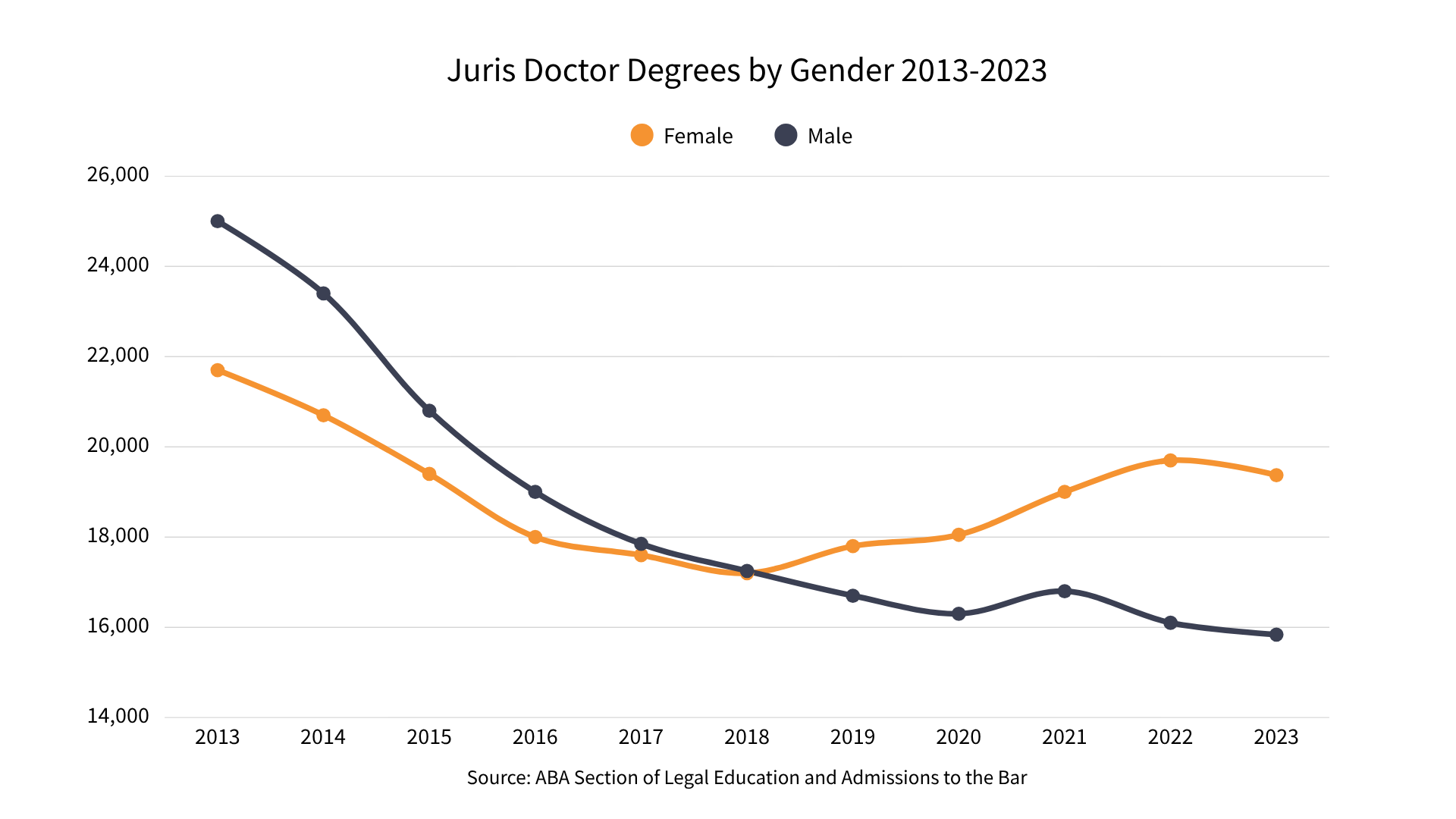
Today, women lawyers reap the benefits of a more welcoming environment made possible by previous generations. Recent statistics demonstrate just how much progress has been made in the inclusivity of women throughout the profession. In law school, the number of female law students has steadily increased since 2016.[4] On the contrary, the number of male law students has decreased since 2010.[5] With these trends, it is not altogether surprising that women first outnumbered men in law school in 2016, making up 50.3 percent of all law students.[6] This gap, which has historically always fallen in the opposite direction, has only continued to grow with women comprising 56 percent of all law students as of 2024.[7]
Trends in positions throughout the legal field have likewise shifted. From 2019 to 2023, 12,175 more women earned Juris Doctor degrees than men, meaning approximately 12,175 more women than men entered the legal field during that timeframe.[8] Shortly following this trajectory, in January 2024, the National Association for Law Placement, which surveys firms to track diversity amongst lawyers, announced a record-breaking milestone: women officially represented the majority of law firm associates for the first time ever.[9]
Around this turning point, a multitude of other legal professions saw similar changes. As of December 2023, the majority of lawyers in the executive branch of the federal government (51.5 percent) were women and only slightly less than half of full-time law school faculty (49.2 percent) were women.[10]
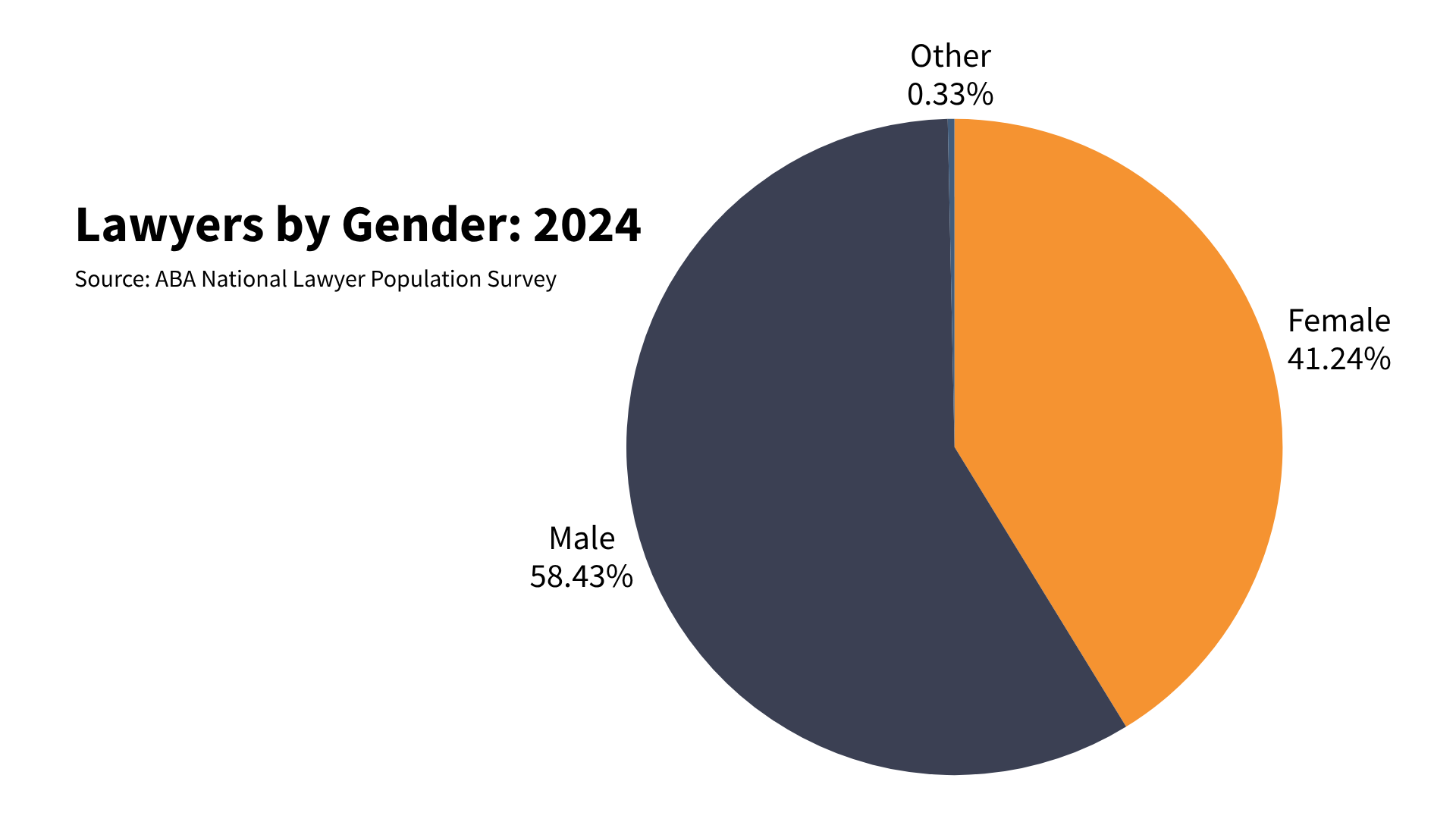
The percentage of women lawyers overall has grown exponentially in just over 40 years. While women comprised a mere eight percent of all lawyers in 1980, they comprised 41 percent in 2024.[11] Despite still making up less than half of lawyers, this 33 percent jump has made a tremendous difference in women’s representation in the legal field.[12]
This greater embodiment of women in law directly affects the impact female lawyers are able to make today. Rather than having to fight for a seat at the table, women can more easily find their spot and contribute meaningfully to the conversation happening there. It is very easy for women lawyers today to take for granted the place past generations fought for them to have. It is paramount that current women in law not only appreciate how far women have come in the legal field but also strive to fill the gaps that still persist today.
The prevalence of Diversity, Equity, and Inclusion (DEI) today likewise contributes to a more welcoming environment for women in law. Through DEI frameworks, legal professions of all kinds promote the fair treatment and full participation of historically underrepresented groups in the workforce, including women. The focus on these three values—diversity, equity, and inclusion—has helped positively reshape expectations in the legal field, especially around access to work, retention, and the possibility of building a sustainable career. Women in law today, importantly, no longer need to create these initiatives for themselves. Instead, they are interwoven and commonplace across legal workforces.
The benefits reaped by women through DEI efforts are far reaching. From more flexible work policies to accommodate varying stages of family life to leadership development programs aimed at promoting women, the impact of DEI is significant. Women today must not take this progress lightly but rather appreciate it for what it is: a profound step forward for women and a reality that was not readily available to those who made it possible.
Due to these DEI initiatives and the work of past generations, the conversation among women in law today surrounding family life has shifted considerably. There is less fear surrounding the impact that having a family will have on a woman’s ability to promote or make partner in her firm. However, the disproportionate responsibilities placed upon wives and mothers are still prevalent. Women’s unique role in life of bearing children will always mean to some extent that women must manage periodic disruptions in their careers that are not shared by men.
A mother’s disproportionate responsibilities after childbearing; however, do not have to persist to the same extent. Through the progress made by women who have excelled in their careers, the ideology surrounding both men and women’s roles in society has greatly evolved. Men today play a greater role in child rearing such that the responsibilities do not fall as heavily on mothers but are rather shared more equitably. While the costs and availability of childcare still pose difficulties for families today, increased flexibility in work policies allow parents to navigate these challenges together as opposed to letting the burden fall on mothers alone.
Through reflection and appreciation, women in law today can recognize not just how far they have come but how far they are capable of going. This mindset will allow the current generation of female lawyers to continue to pave the path of the women at their heels.
The Battles Yet to Be Won for Future Women Lawyers
Despite all the great progress made, there is still considerable room for growth for women in law today. This growth is primarily attributable to the present gap in the representation of women in leadership roles. Although women comprise the majority of law associates, they make up a distinct minority of all law firm partners. This area has seen less growth historically; in 2013, a mere 20 percent of law firm partners were women and in 2023, a whole decade later, that percentage grew only to 28 percent.[13]
This underrepresentation of women in leadership perpetuates additional disparities for women in respect to equitable pay, responsibilities, and mentorship. According to the ABA Journal, women lawyers earned 29 percent less than men lawyers in 2024.[14] This gap fell only five percent from 2022, when women in the legal field were earning 34 percent less than men.[15]
With fewer women in positions of power, fewer female mentors in the upper echelons of firms likewise exist both for current and future women lawyers. This reality necessitates that women currently in leadership positions accept the responsibility of developing fellow female lawyers. However, this burden is not theirs to bear alone. Men and women in leadership alike must work to uplift and prepare current and future women to be leaders through outreach, mentorship, and programs.
The everchanging landscape of law through technological advancements including Artificial Intelligence (AI) make it more important than ever for women to have a voice in how new systems affect the day-to-day work of lawyers. While AI has the potential to level the playing field of present workloads by cutting down on monotonous tasks and making legal services more efficient, it likewise has the potential to widen gaps in workplace responsibilities if women are not included in shaping how these tools are used, adopted, and valued.
Technological advancements have also placed greater expectations on lawyers generally. Clients’ access to lawyers and the law is at the tip of their fingers, more so than ever before, especially given the pervasive use of AI. All lawyers now feel the pressure of meeting the ever-growing demands of clients through immediate communication and constant availability. Without input from women regarding managing client expectations, this burden may disproportionately impact a group that already tends to carry a greater share of family responsibilities.
The legal field today still needs a culture that values outcomes over constant visibility. Through the accessibility of technology, this shift is possible but will require open mindedness and continued efforts by leadership and women to reshape what is valued and how it is rewarded.
Creating a legacy for women today will in turn leave one for the women still to come. Only by striving to make the legal field more inclusive for all humans—men and women alike—can we better serve our communities, one another, and our future generations.

Randi Johnson graduated from Lewis & Clark Northwestern School of Law in 2006 and has practiced since 2007. Over the course of her career, she has practiced Social Security Disability and Veteran’s Disability Law, Estate Planning, Guardianships, and Special Education Law. She is currently the Chief Growth Officer, Principal, and Managing Attorney at Gravis Law.

Penelope Gaffney graduated from the University of San Francisco School of Law in 1997. Throughout her career, she has worked for the United States Court of Appeals for the Ninth Circuit and practiced Family Law, Estate Planning, and Probate. She is currently a Senior Attorney & Principal at Gravis Law in Boise, Idaho.
[1] Women in the Legal Profession, Am. Bar Ass’n, https://www.americanbar.org/news/profile-legal-profession/women/ (last visited March 26, 2026).
[2] Demographics, Am. Bar Ass’n, https://www.americanbar.org/news/profile-legal-profession/demographics/ (last visited March 26, 2026).
[3] Women in the Legal Profession, Am. Bar Ass’n, https://www.americanbar.org/news/profile-legal-profession/women/ (last visited March 26, 2026) (stating that the ABA only began tracking the statistics of women law firm associates beginning in 1991, when 38.4 percent of all law firm associates were women).
[4] Id.
[5] Id.
[6] Id.
[7] Id.
[8] Id.
[9] Id.
[10] Id.
[11] Demographics, Am. Bar Ass’n, https://www.americanbar.org/news/profile-legal-profession/demographics/ (last visited March 26, 2026).
[12] Id.
[13] Women in the Legal Profession, Am. Bar Ass’n, https://www.americanbar.org/news/profile-legal-profession/women/ (last visited March 26, 2026).
[14] Sarah Frazier, Incremental Narrowing of Pay Gap Between Men and Women Nevertheless Leaves Women Disadvantaged in Compensation, Feedback, and Representation in Highest Echelons of Law, Am. Bar Ass’n, (Aug. 5, 2025) https://www.americanbar.org/groups/health_law/news/2025/narrowing-pay-gap-men-women/.
[15] Id.