
Proof under the Influence: The Suspiciously Confident DRE
By David Delyea
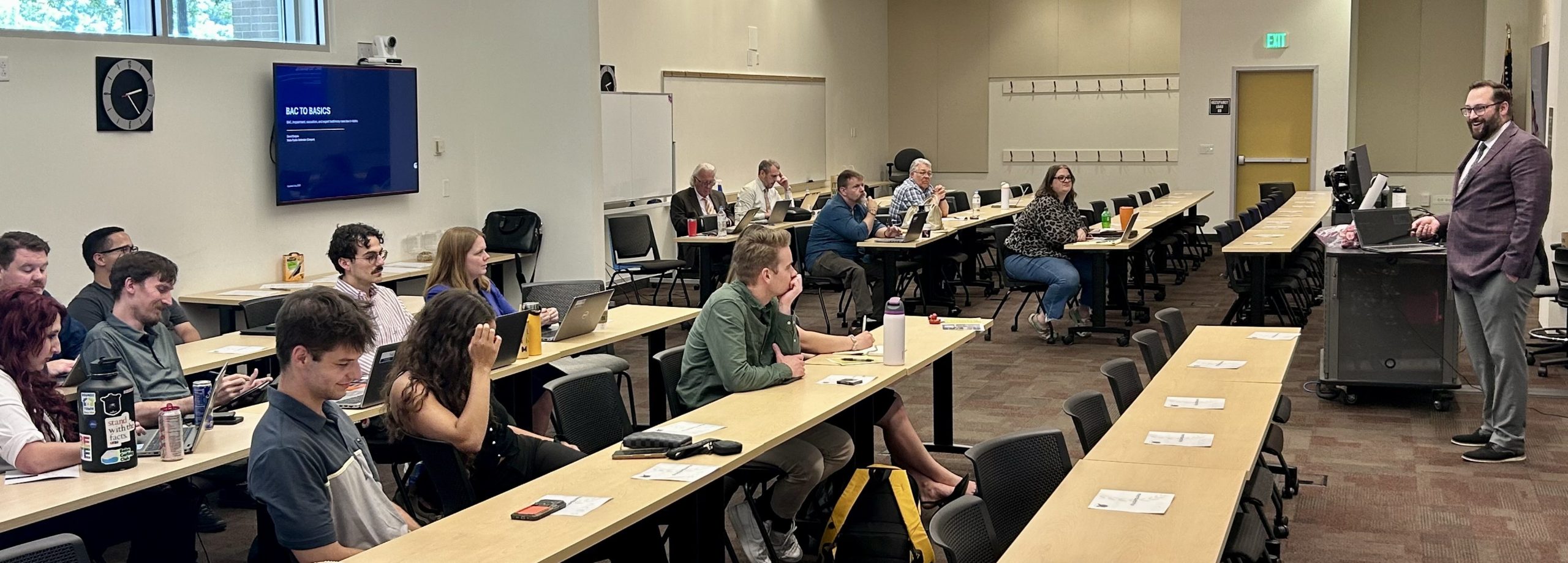
Alcohol and drug-based DUI prosecutions ask juries to answer the same ultimate question: whether the defendant drove while under the influence of an intoxicating substance. The difficulty arises in determining what evidence is relevant, admissible, and sufficient to prove that charge. Alcohol prosecutions often revolve around a breath or blood test that produces a numerical result. Further, alcohol DUIs often include discussion of the standardized field sobriety tests (SFST): the horizontal gaze nystagmus test, which observes eye movement for nystagmus or lack of smooth pursuit; the walk-and-turn, which requires a person to walk heel-to-toe, turn, and return; and the one-leg stand, which requires balancing on one leg.
Prosecution based on drug use, as opposed to alcohol use, frequently relies on law-enforcement observations and a battery of procedures known as a Drug Recognition Evaluation, performed by a trained Drug Recognition Evaluator (DRE), who may conclude that the observed signs are consistent with one or more drug categories. The jury then may use this information to determine if someone was under the influence of any combination of drugs in their system. As with any evidence, however, the structure and apparent seal of approval of the DRE protocol can make its conclusions appear more certain than the governing law or underlying science supports.
The central question under Idaho DUI law is not whether DRE evidence can be useful, it can, but what the evidence actually proves. A properly performed evaluation may help a jury consider alternative explanations, understand the signs associated with various drug categories, and assess whether those signs are consistent with the defendant’s observed condition.
But the evaluation does not necessarily establish drug presence, correctly identify a drug category, prove impairment, or connect any impairment to an intoxicant at the time of driving. Idaho’s developing DRE caselaw, therefore, presents a causal-bridge problem: admissible observations and toxicology evidence must still be connected to the statutory element of impairment caused by alcohol, drugs, or another intoxicating substance at the relevant time.
Decoding the Origin: Drug Recognition Evaluation
Officers trained to evaluate whether a person exhibits signs associated with one or more of seven drug categories (central nervous system depressants, central nervous system stimulants, hallucinogens, dissociative anesthetics, narcotic analgesics, inhalants, and cannabis), are commonly called Drug Recognition Evaluators, or DREs. Although the terms “evaluator” and “expert” are sometimes used interchangeably, they serve different functions. “Evaluator” describes the officer’s certification and role in administering the protocol; “expert” describes the evidentiary capacity in which the witness offers opinion testimony.
Idaho law requires prospective disclosure of DRE opinion testimony under Idaho Criminal Rule 16(b)(7), but the jury remains the sole judge of credibility and the weight of the testimony.[1] The evaluation itself consists of interviews, physical measurements, divided-attention tests, clinical observations, and other steps that are compared with expected findings summarized in the DRE matrix.[2]
The Drug Evaluation and Classification program originated within the Los Angeles Police Department in the 1970s, and was later developed into a national curriculum in collaboration with the National Highway Traffic Safety Administration (NHTSA); it was not originally developed by some scientific organization.[3] Three early studies are frequently cited as foundational validation studies for the DRE process. Greg Kane has argued that significant methodological limitations in those studies undermine broad claims about the protocol’s reported accuracy.[4] Likewise, the principal validation studies underlying the standardized three-test SFST battery measured the tests’ ability to discriminate based on blood-alcohol concentration; they did not validate the battery as a diagnostic test for impairment caused by cannabis or drugs generally.[5] Even so, the tests and observations became embedded in impaired-driving investigations nationwide. Their methodological limitations do not render the observations irrelevant; rather, those limitations become important when the evidence is used to support conclusions broader than the underlying research can reliably establish.
Same Evidence, Different Question
There are two primary ways for the State to prove DUI. The first is per se DUI, based on a valid alcohol test showing a BAC of .08 or higher, together with evidence that the defendant has previously driven a motor vehicle. The second is impairment DUI, which requires proof that drugs, or a combination of drugs and/or alcohol impaired the defendant’s ability to operate a motor vehicle. Idaho has developed a substantial body of caselaw addressing relevance in per se DUI prosecutions, although those decisions are not always applied carefully outside that context. In State v. Robinett, the Idaho Supreme Court held that the defendant’s blood-alcohol level was only relevant based on the charged theory, impairment or per se theory.[6] In Elias-Cruz v. Idaho Dep’t. of Transportation, the Court explained that, in an administrative per se suspension proceeding, the statutory inquiry centered on the test result obtained and that the driver’s actual blood alcohol content was irrelevant to the charge.[7]
State v. Tomlinson later treated certain evidence offered to contradict a per se test result as irrelevant, such as retrograde extrapolation evidence.[8] Retrograde extrapolation, otherwise known as the “rising BAC” defense, is a calculation estimating the defendant’s BAC at the time of driving as opposed to when the test was taken. In 2018, however, State v. Austin rejected Tomlinson’s overly restrictive reasoning and held that a defendant may offer relevant evidence challenging the reliability or meaning of the State’s test result, including appropriate retrograde-extrapolation evidence.[9] This opened the door for defense attorneys to attack the reliability of the specific machine used through various means.
Those per se decisions do not resolve the evidentiary questions presented by an impairment-based DUI. In a drug-impairment case, a toxicology report is not a verdict form, and a DRE matrix is not a statutory element. A positive toxicology result may establish exposure, use, the presence of a parent drug or metabolite, or some combination of those facts but does not prove impairment. Likewise, poor performance on a field sobriety test may be consistent with impairment, but it may also have non-intoxicant explanations such as age, injury, fatigue, anxiety, medical conditions, neurologic symptoms, poor instructions, environmental conditions, or ordinary balance and coordination differences. Evidence relevant to one DUI theory is not necessarily relevant to another.[10] A per se prosecution focuses on the statutorily specified test result, while an impairment prosecution focuses on the defendant’s condition and the cause of any impairment at the time of driving.[11]
The Missing Link: Causation
Idaho law does not require the State to prove a particular degree or label of intoxication, but the second sentence of Idaho Criminal Jury Instruction 1006 is sometimes overlooked: “Rather, the state must show that the defendant [had consumed sufficient alcohol] [and/or] [had used enough of (any drug(s)) (or) (intoxicating substance(s)) to influence or affect the defendant’s ability to drive the motor vehicle.” Stark states the corresponding causation requirement plainly:
To prove that a person is guilty of driving under the influence, the State must prove more than a driving impairment. The State must also present evidence, besides the impairment itself, to prove that the impairment was caused by alcohol, drugs, or intoxicating substances. Proving an impairment does not prove the cause of the impairment.[12]
Thus, in an impairment prosecution, relevance extends beyond whether a test was administered or a substance was detected. The evidence must support a logical connection among the defendant’s condition, the intoxicating substance, and the time of driving. State v. Morin illustrates the point: evidence of carboxy-THC, an inactive metabolite, did not by itself establish intoxication or impairment, and expert testimony was necessary to explain whether the toxicology evidence supported an inference of impairment.[13]
Toxicology ordinarily answers a limited question about what was detected in a specimen collected at a particular time. Driving behavior may support an inference of impairment but does not, standing alone, identify its cause. Field sobriety performance likewise is evidence to be interpreted, not conclusive proof. To support conviction, the evidence must permit a rational factfinder to connect the alleged impairment to an intoxicant at the relevant time.
A Budding Problem
Cannabis evidence is a useful pressure test for current DRE practices because its pharmacology and observable effects do not track alcohol in a simple or predictable way. The DRE matrix itself reflects that limitation. Several expected findings for cannabis remain within normal ranges; for example, cannabis is not ordinarily associated with horizontal gaze nystagmus, elevated body temperature, or altered muscle tone. Other findings, such as increased pulse, elevated blood pressure, pupil-size changes, or lack of convergence, are neither universal nor unique to cannabis. The matrix therefore identifies patterns that may be consistent with a drug category; it does not independently establish ingestion, impairment, causation, or the defendant’s ability to drive safely.
National public health and forensic sources likewise caution that blood THC concentration does not correlate with impairment as predictably as blood-alcohol concentration.[14] The National Academies has similarly concluded that blood THC levels are not well correlated with impairment or recent use.[15] This creates a double-edged evidentiary problem. The DRE protocol may gather observations that provide context beyond a toxicology result. At the same time, an evaluator’s categorical conclusion may be overstated if it does not account for timing, alternative explanations, toxicological limitations, and the distinction between signs consistent with cannabis use and proof of cannabis-caused impairment. Without careful handling or with a tad too much zealous prosecution, this could increase the risk of wrongful convictions..
An End to Expert-ish Testimony: The Dacey-Hinkel Boundary
Attorneys sometimes use labels such as “pseudo-expert” or “hybrid witness” to describe an officer who recounts observations while also drawing on specialized training. Idaho’s recent cases provide a more useful rule: the classification turns on the nature of the testimony, not the witness’ job title. In Dacey, the Idaho Supreme Court announced a brightline rule: “Moving forward, a drug recognition expert must be disclosed as an expert witness under Idaho Criminal Rule 16(b)(7).”[16] An officer may ordinarily describe personal observations and the standardized administration of SFSTs without offering an expert opinion due to the fact it is standardized and leaves little room for interpretation.
But in State v. Hinkel, when the officer applies specialized training and knowledge to interpret the totality of the circumstances and form an independent opinion, on any subject, the testimony falls within Idaho Rule of Evidence 702.[17] Dacey and Hinkel therefore require practitioners and courts to identify, before trial, which portions of an officer’s proposed testimony are factual observations, which are lay opinions, and which are expert interpretations requiring disclosure and a proper foundation.
The Evidence Minefield
Several practical evidentiary issues follow. SFST observations may be relevant in a suspected drug-impaired-driving case, but the proponent should not import alcohol-validation statistics or characterize the standardized battery as independently validated to diagnose impairment from cannabis or drugs generally. Therefore, there should be significant limitations to their use in an impairment only DUI. A DRE evaluation may add specialized observations and interpretation, but its conclusions are not self-proving, particularly in a cannabis case.
Toxicology testimony should be carefully limited to prevent vocabulary drift, such as treating use, presence, intoxication, and impairment as interchangeable concepts. Expert disclosure should identify the opinions the DRE will offer, the facts and data considered, the bases and reasons for those opinions, the report or evaluation, relevant training and certification information, and any additional material discoverable under the governing rules or necessary to litigate reliability and foundation.
Courts and practitioners should also be prepared to address questions that Idaho appellate decisions have not fully resolved. What foundation permits a DRE to opine about a defendant’s actual ability to operate a motor vehicle, rather than merely identifying signs consistent with a drug category? When no DRE evaluation was completed, what inferences may properly be drawn from SFST observations alone? What training or scientific basis qualifies an evaluator to connect a detected substance to impairment at the time of driving? Stark, Morin, Dacey, and Hinkel require careful separation of observation from interpretation, drug presence from impairment, and impairment from causation.
The Final Evaluation
DRE evidence can be useful in an impairment-based DUI prosecution by organizing observations and identifying a possible drug category, but it does not necessarily answer every question required to carry the State’s burden. The remaining gap is the causal bridge connecting the observed condition, the intoxicating substance, and the time of driving.
The soundest approach is disciplined admissibility analysis: identify the charged theory; separate factual observations and lay testimony from expert interpretation; require meaningful expert disclosures; limit each item of evidence to the proposition it can reliably support; and insist that every element be proved beyond a reasonable doubt. Under that framework, DRE testimony may assist the factfinder without being given more certainty or scope than the law and science justify. That approach is not inherently pro-defense or pro-prosecution; it is the application of ordinary evidentiary principles to an unusually complex category of DUI evidence.

David Delyea graduated from the University of Idaho College of Law in 2018 and began working as a public defender in 2019. Throughout his career, he has represented clients in cases ranging from misdemeanors to serious felonies, developed a particular interest in DUI litigation and evidence, and has argued before the Idaho Supreme Court.
[1]See State v. Dacey, 169 Idaho 102, 111–12, 491 P.3d 1205, 1214–15 (2021).
[2] See DWI Detection and Standardized Field Sobriety Test (SFST) Resources, Nat’l Highway Traffic Safety Admin., https://www.nhtsa.gov/dwi-detection-and-standardized-field-sobriety-test-sfst-resources.
[3] See Drug Recognition Expert (DRE) Classroom Course, Cal. Highway Patrol, https://www.chp.ca.gov/programs-services/for-law-enforcement/drug-recognition-evaluator-program/schedule-of-classes/dre/.
[4] Greg Kane, The Methodological Quality of Three Foundational Law Enforcement Drug Influence Evaluation Validation Studies, 12 J. Negative Results BioMed. 16 (2013), https://link.springer.com/article/10.1186/1477-5751-12-16.
[5] See DWI Detection and Standardized Field Sobriety Test (SFST) Resources, Nat’l Highway Traffic Safety Admin., https://www.nhtsa.gov/dwi-detection-and-standardized-field-sobriety-test-sfst-resources.
[6] 141 Idaho 110, 113–15, 106 P.3d 436, 439–41 (2005).
[7] 153 Idaho 200, 204–06, 280 P.3d 703, 707–09 (2012).
[8] 159 Idaho 112, 119–23, 357 P.3d 238, 245–49 (Ct. App. 2015).
[9] 163 Idaho 378, 381–84, 413 P.3d 778, 781–84 (2018).
[10] Tomlinson, 159 Idaho at 119, 357 P.3d at 245.
[11] State v. Stark, 157 Idaho 29, 31, 333 P.3d 844, 846 (Ct. App. 2013).
[12] 157 Idaho at 31, 333 P.3d at 846.
[13] 158 Idaho 622, 626–29, 349 P.3d 1213, 1217–20 (Ct. App. 2015).
[14] See Field Sobriety Tests and THC Levels Unreliable Indicators of Marijuana Intoxication, Nat’l Inst. of Just. (Apr. 5, 2021), https://nij.ojp.gov/topics/articles/field-sobriety-tests-and-thc-levels-unreliable-indicators-marijuana-intoxication.
[15] Nat’l Acads. of Scis., Eng’g & Med., Overview of Cannabis Policy, in Cannabis Policy Impacts Public Health and Health Equity 63, 83 (2024), https://www.nationalacademies.org/read/27766/chapter/4#83.
[16] 169 Idaho 102, 111, 491 P.3d 1205 (2021).
[17] State v. Hinkel, Docket No. 51754, 2026 Ida. App. LEXIS 23 (Ct. App. May 18, 2026).