
2026 ABA Annual Meeting in Chicago
By Kendall Bjornsen
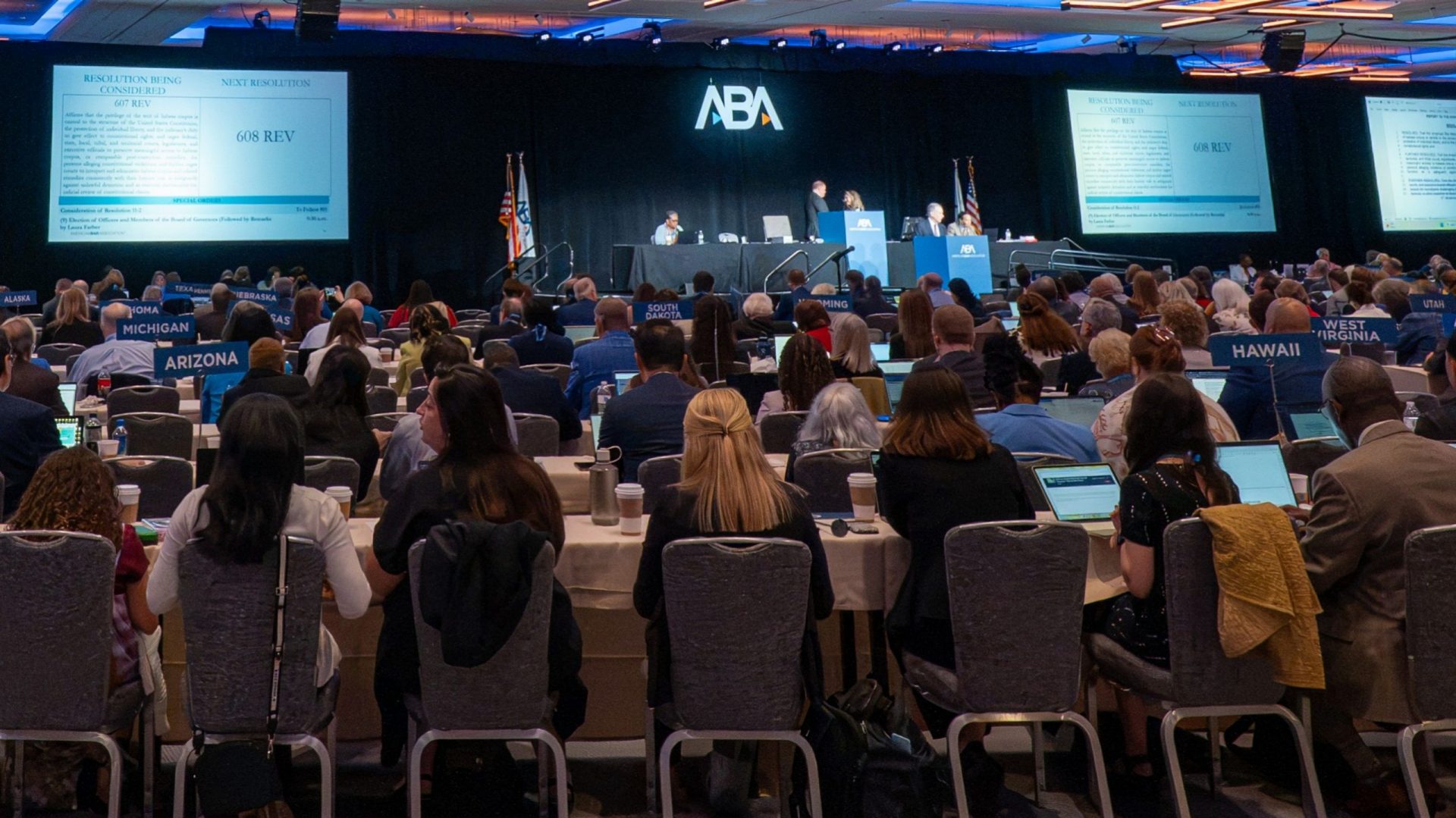
This year’s American Bar Association (ABA) Annual Meeting was held in Chicago, Illinois, the primary headquarters of the ABA. I have the privilege of serving in several capacities and representing Idaho with the ABA. I am Idaho’s Young Lawyer Delegate to the ABA’s House of Delegates as well as Idaho’s Delegate to the Young Lawyers Division of the ABA and a member of the Young Lawyers Division (YLD) Council representing Idaho and Montana (District 30) for the Young Lawyers Assembly. In my roles, I attend the Young Lawyers Assembly as well as the House of Delegates Assembly over the weeklong conference. This year’s conference focused on celebrating and reflecting on the 250th anniversary signing of the Declaration of Independence. In particular, the conference focused on honoring the profound legacy of the lawyers who helped build America and inspired countless movements for freedom and justice throughout the world.
As I waited for the YLD Assembly to begin, I looked around the room at hundreds of young lawyers representing every corner of the country. It struck me that each person had traveled a different path to get there, yet we all shared the same responsibility: helping to shape the future of our profession. This Assembly featured some of the most robust debate and overall engagement from state delegates of any assembly I have attended. The YLD Assembly considered and adopted several resolutions addressing issues affecting law students, the legal profession, access to justice, and the administration of the bar examination. Some of the notable resolutions debated and adopted were:
26-12YL – Law Student Well-Being Under HOD 18M105[1]
This resolution seeks to build upon American Bar Association Resolution 105 by encouraging greater transparency, accountability, and institutional engagement in promoting law student well-being. Specifically, it aims to address the current lack of structured mechanisms to assess how law schools are implementing the principles of Resolution 105 and to promote measurable, institution-wide efforts that support the development of emotionally competent and professionally resilient lawyers.
25-6YL (REV) – Legal Resource Hubs[2]
Encourages public libraries and library systems, legal aid and legal services organizations, bar associations, law schools, community organizations, pro bono networks, and other qualified entities to provide foundational legal resources and improve community legal literacy, including through Legal Resource Hubs and digital legal resource infrastructure (“Digital Law Libraries”) in public libraries.
HOD Resolution 509 – Higher Education for Tribal Nations[3]
Urges federal, state, and private institutions of higher education to recognize that delivering educational and support services to Tribal citizens, a status determined by Tribal nations, is aligned with the United States’ trust responsibility and reflects the nation-to-nation relationship between the United States and Tribal nation.
HOD Resolution 510 – Professional Conduct for DOJ Attorneys[4]
Affirms support for state, territorial, and tribal lawyer disciplinary authorities’ continued work, consistent with the McDade Amendment (28 U.S.C. § 530B), to enforce applicable rules of professional conduct by investigating and adjudicating complaints against attorneys employed by the Department of Justice under applicable laws and rules to the same extent and in the same manner as applicable to all attorneys within their jurisdiction.
HOD Resolution 606 – Full Firm Membership[5]
Recognizes organization-sponsored membership models with program-based pricing (such as the Full Firm Membership Program and Full Faculty Membership Program) as participation pathways within Special Membership Programs under the Association’s policy framework.
There were also several resolutions on the YLD Consent Calendar including three that dealt with the bar exam. They are as follows:
26-6YL – Increased Bar Passage Rates[6]
Urges all ABA-accredited law schools to adopt and implement comprehensive, evidence-based programs designed to improve bar examination passage rates among graduates.
26-10YL – LSAC and Bar Exam Accountability[7]
Remote testing has greatly expanded opportunities for many test-takers, especially those who cannot travel easily, have job or family obligations, or require disability accommodations that work better in controlled environments. However, challenges remain with both remote proctoring and traditional in-person testing, including technical issues, ignored medical emergencies, a lack of effective proctors, uneven support for accommodations, and security measures that can feel excessive or arbitrary. This resolution focuses on solving the operational mechanics causing the harm, without ending remote exams, by requiring technology controls that protect examinee time, accessibility-first design, standardized proctor conduct, transparent metrics, and meaningful remedies.
26-13YL – Report to The House of Delegates[8]
This resolution urges the highest court or bar admissions authority of a jurisdiction that adopts the NextGen Uniform Bar Exam (“NextGen UBE”) or other bar exam format that requires an Internet connection to collaborate with each testing facility, all software providers, and other vendors.
Beyond the substance of the individual resolutions, what stood out to me most was the level of engagement and thoughtful debate throughout the Assembly. Each resolution reflected a different challenge facing our profession, but the discussion surrounding them highlighted the important role that the YLD can play in identifying emerging issues and bringing the perspectives of newer lawyers to the broader ABA.
Serving as a state delegate also reinforced for me the importance of having Idaho represented in these conversations. Our participation allows us not only to bring Idaho’s perspectives to the national level, but also to bring ideas and resources back to our state and our own legal community. I know many Idaho communities who would benefit from legal resources hubs and access to legal resources. As someone who survived and, at times, did not necessarily thrive during law school, I know I support greater transparency, accountability, and institutional engagement in promoting law student well-being. These resolutions and conversations matter. They matter on a macro scale of the ABA but they also matter when I bring these discussions back to our Board of Commissioners for review and discussion on how we may implement them into our Bar and with our members. These Resolutions have the ability to impact our day-to-day experiences as Idaho attorneys, but the conversations also have the ability to impact the future successes and well-being of future attorneys.
I left the Assembly reminded that the direction of our profession is shaped not only by the decisions made by our courts and legislatures, but also by the conversations we have as lawyers and the organizations in which we choose to participate.
The YLD Assembly was just one part of the larger ABA Annual Meeting. Following the YLD Assembly, the focus shifted to the House of Delegates, where many of these issues—and others affecting the profession and the public—were considered on a broader scale.
The House of Delegates addressed more than 40 policy matters on a wide variety of issues including the independence of the legal profession and judiciary, warrantless immigration searches and arrests, law enforcement protocols, law student recruitment, funding for Historically Black Colleges and University law schools as well as several lawyer ethics and model rules.[9] As a reminder, the House encompasses nearly 600 delegates from ABA entities and state, local and specialty bar associations. House proposals do not become ABA policy until they are approved by the House, which meets twice annually (mid-year and annual meetings).
Some of the resolutions adopted were:
Resolution 400: Adopts the Pledge to Preserve the Independence of the Legal Profession and the Judicial System as an affirmation of the legal profession’s commitment to the rule of law, the independence of the profession, the Constitution and our legal system.[10]
Resolution 515: Encourages all entities that provide educational opportunities to lawyers to implement “Practice Readiness Programs” in order to equip newly licensed lawyers with practical skills and competencies essential to the transition from law school to the practice of law.[11]
Resolution 405: Urges the bar admissions authority of a jurisdiction that adopts the NextGen Uniform Bar Exam or other bar exam format that requires an Internet connection to collaborate with each testing facility, all software providers and other vendors to sufficiently ensure that all technology is in good shape in advance of the examination date.[12]
Resolution 516: Urges bar admissions authorities to develop and publish policies with clear deadlines governing the portability of Uniform Bar Examination and NextGen Bar Exam scores.[13]
Resolution 511: Urges federal, state, local, territorial and tribal law enforcement agencies to prohibit the routine use of face coverings, masks or other identity concealing gear absent narrowly defined and documented situations where temporary anonymity is essential to officer or public, safety and to ensure that whenever face coverings are used under such circumstances, law enforcement officers and agents must display clearly visible, unique and verifiable identification throughout the encounter.[14]
The breadth of these resolutions reflects the unique role of the House of Delegates in setting policy for the ABA and addressing issues that affect both the legal profession and the public we serve. What I found particularly valuable was seeing how these issues were considered from a national perspective, with delegates bringing different experiences and priorities to the discussion. The House also provided an opportunity to look beyond individual policy matters and consider the broader direction of the Association as it begins a new year of leadership.
Another important part of the Annual Meeting was the transition to a new ABA President, which marked an opportunity to reflect on the Association’s priorities and the role the ABA can play in responding to the challenges facing the profession.
Outgoing ABA President Michelle A. Behnke of Wisconsin and incoming ABA President Barbara J. Howard of Ohio delivered remarks to the House. Howard has long been active in bar association leadership since her involvement in the ABA Young Lawyers Division. She has been a member of the ABA’s policymaking House of Delegates since 1986 and served as chair of the House from 2020 to 2022. She also served on the ABA Board of Governors, the ABA Journal Board of Editors and the board of the American Bar Foundation.
In the ABA House of Delegates, she served on the Nominating Committee from 2002-2005 and again from 2010-2020, then as Ohio’s State Delegate. Howard has served on the House Committees on Rules and Calendar, Resolution Impact, Technology and Communications, Issues of Concern to the Profession, Select, Credentials and Admissions, Drafting and Steering Committee of the Nominating Committee.[15] These contributions exemplify her strong dedication to the ABA and to the legal community as a whole. I am very excited to see where Howard takes the ABA and to have a seat at the table with her.
One quote that particularly stuck with me was when Howard said, “When lawyers act together, we are truly a formidable force for democracy.”[16] This quote reminds me that while the issues before us were varied, they were all connected by a common purpose: strengthening our profession and the justice system we serve. That sentiment captured what I saw throughout both the YLD Assembly and the House of Delegates. While nearly 600 delegates may bring different experiences, perspectives, and priorities to the table, the power of the ABA comes from our willingness to engage in difficult conversations, find common ground, and act collectively.
It also brought me back to the thought I had at the beginning of the YLD Assembly—that each person had traveled a different path to get there, yet we all shared the same responsibility: helping shape the future of our profession. Whether through a resolution adopted by the YLD, a policy decision of the House of Delegates, or the leadership of a new ABA President, the Annual Meeting demonstrated the impact that lawyers can have when we come together with a shared commitment to the profession, the rule of law, and the communities we serve.
I am honored to serve in my roles with the ABA and to be part of that collective effort—representing Idaho, contributing to the conversations that shape our profession, and helping demonstrate just how formidable we can be when we act together. The next meeting will be held during the ABA Midyear Meeting, Jan. 27-Feb. 1, 2027, in Chicago.[17]

Kendall Bjornsen serves as General Counsel and Corporate Secretary at Idaho Trust Bancorp and its subsidiaries. Kendall manages corporate legal matters and coordinates outside legal counsel. She holds a Bachelor of Art’s degree in Peace and Conflict Studies from the University of California at Berkeley and a Juris Doctorate degree from the University of Idaho College of Law. When she is not working at Idaho Trust or volunteering, you will likely find her somewhere in the North End of Boise with her dog Wally and husband Ethan.
[1] https://www.americanbar.org/groups/young_lawyers/events/annual/assembly/
[2] Id.
[3] Id.
[4] https://www.americanbar.org/groups/young_lawyers/events/annual/assembly/
[5] Id.
[6] Id.
[7] Id.
[8] https://www.americanbar.org/groups/young_lawyers/events/annual/assembly/
[9] https://www.americanbar.org/news/abanews/aba-news-archives/2026/08/aba-hod-actions-annual-conference/?utm_source=sfmc&utm_medium=email&utm_campaign=&promo=&RefId=&utm_id=1242754&sfmc_id=52274524
[10] https://www.americanbar.org/news/abanews/aba-news-archives/2026/08/aba-hod-actions-annual-conference/?utm_source=sfmc&utm_medium=email&utm_campaign=&promo=&RefId=&utm_id=1242754&sfmc_id=52274524
[11] Id.
[12] Id.
[13] Id.
[14] Id.
[15] https://www.americanbar.org/news/abanews/aba-news-archives/2026/08/barbara-howard-becomes-aba-president/
[16] Id.
[17] https://www.americanbar.org/news/abanews/aba-news-archives/2026/08/aba-hod-actions-annual-conference/?utm_source=sfmc&utm_medium=email&utm_campaign=&promo=&RefId=&utm_id=1242754&sfmc_id=52274524