
Outgoing President’s Message by Hon. Robert L. Jackson
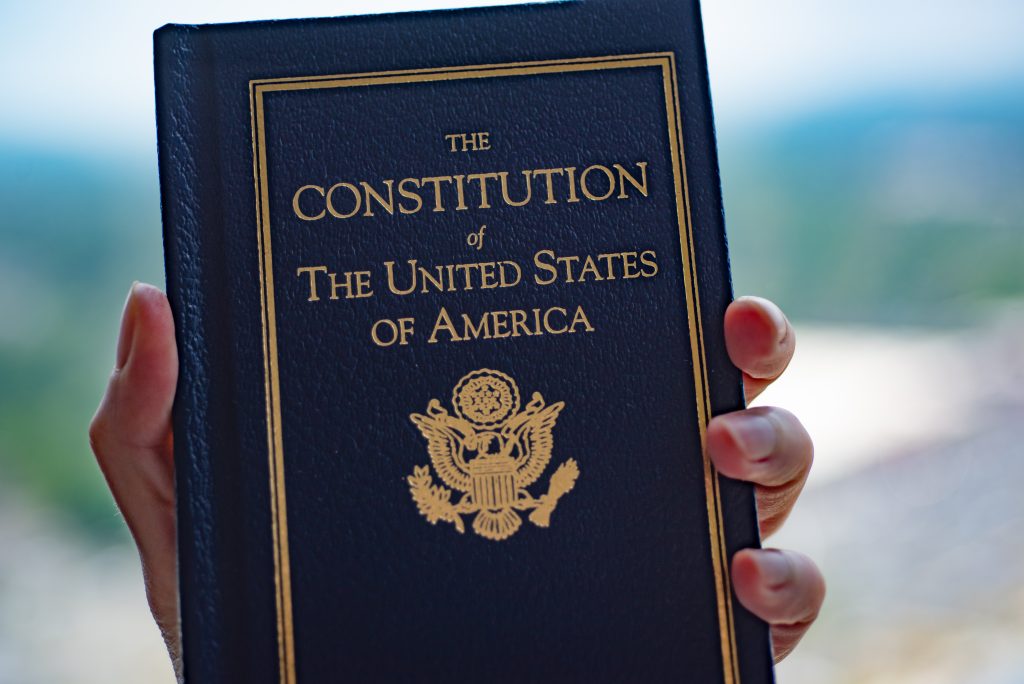
This is my parting column as President of the Idaho State Bar. I have to say that the last three years on the Board of Commissioners have been very rewarding, not only because of the comradery with my fellow commissioners, executive directors, all of the Bar Counsel attorneys, and the entire Law Center staff, but because of the opportunity to better understand the inner workings of the Bar. I have a newfound appreciation for those Bar employees’ desires, attitudes and actions to perform their jobs with the goal of promoting the interests and wellbeing of not only our Bar members, but also the public. Those employees have shown such dedication to running and improving the workings of this organization. I applaud, commend, and respect them.
The Religion Clauses
As you may have come to notice, I have an appreciation (some might say a zeal) for our founders who developed the Constitution and the Bill of Rights. Specifically, with the research help of 2L University of Idaho College of Law student, Logan Graham, I have channeled my élan to the First Amendment, one of the foundational provisions of the Bill of Rights ratified on December 15, 1791.
There are four major topics addressed by that one-sentence amendment. One of those core protections is “religion”. Establishing protection for religious freedom was of paramount importance to many of the founders for good reason.[i] During British colonialism, England had established “official” churches within the colonies and persecuted those who observed sects and faiths outside of the churches created by the Crown.[ii] With an eye towards ensuring that the new federal government would not make such infringements upon religious independence, the founders added the free exercise and establishment clauses to the very first amendment of the newly written Bill of Rights.[iii]
At first glance, the two clauses appear in tension with one another; the free exercise clause requires government to respect individual religious exercise, while the establishment clause in essence requires it to restrain itself from the official recognition of religion. Yet, the very history of these clauses affirms that there is no conflict at all. The indelibly personal nature of this right was readily understood by the founders in the wake of England’s authoritarian control over their independent ability to decide how best to express and observe their faith. Therefore, both of the religion clauses contained in the First Amendment were drafted to recognize “that religious beliefs and religious expression are too precious to be either proscribed or prescribed by the State.”[iv]
Justice William Douglas once summarized the cohesion between the religion clauses quite simply: “Government may not . . . force one or some religion on any person. But we find no constitutional requirement which makes it necessary for government to be hostile to religion and to throw its weight against efforts to widen the effective scope of religious influence. The government must be neutral . . .. It may not thrust any sect on any person.”[v] Considering the effect of government regulation on free exercise, it is true, as Judge Michael W. McConnell of the 10th Circuit Court of Appeals noted, that “government support and control are bad for religion.”[vi] Thus, the founders protected and preserved the full independence of this most sacred right by “erect[ing] ‘a wall of separation between church and State.’”[vii]
“Erecting the ‘wall of separation between church and state’… is absolutely essential in a free society.”
– Thomas Jefferson
Idaho’s Religious Guarantees
Here in Idaho, nearly a century later, the importance of the guarantees contained within the First Amendment was not lost on the 64 residents of the Idaho Territory who signed the document which is now known as the Constitution of the State of Idaho. They did it “in open convention at Boise City, in the territory of Idaho, this sixth day of August, in the year of our Lord, one thousand eight hundred and eighty-nine.”[viii]
There are three Sections in the Idaho Constitution which track the protection of religious liberty and separation of church and state guaranteed in the First Amendment. For the sake of space, I will only highlight the key language here. That said, please read the entire document as any attorney should.
Article I, Section 4 of the Idaho Constitution asserts that “[t]he exercise and enjoyment of religious faith and worship shall forever be guaranteed; and no person shall be denied any civil or political right, privilege, or capacity on account of his religious opinions.”[ix] Moreover, our state government is prohibited from requiring a person “to attend or support any ministry or place of worship, religious sect or denomination, or pay tithes against his consent[,]” as well as from granting “any preference . . . by law to any religious denomination or mode of worship.”[x]
Article IX, Section 5 adds that the political bodies of this State cannot “pay from any public fund or moneys whatever, anything in aid of any church or sectarian or religious society, or for any sectarian or religious purpose . . . .”[xi]
Article IX, Section 6 provides that “no teacher or student of any such institution shall ever be required to attend or participate in any religious service whatever [,]” nor shall “sectarian or religious tenets or doctrines . . . be taught in the public schools.”[xii]
These provisions embody the First Amendment’s core concept of restraining government from imposing itself upon the individual autonomy of religious observance. By the protection guaranteed in both our state and federal constitutions, Idahoans are assured that their liberty with respect to their personal religious choices is shielded from unrestrained commandeering by the State.
Keep Our Constitution at Hand
In recognition of the fundamental role that our constitutional protections play in our everyday lives, I encourage you to obtain a copy of the Idaho Constitution and treat it as the special document it is. Our Secretary of State, Phil McGrane, has elected to present a special pocket-sized edition of the Idaho Constitution as part of the continued celebration of the two hundred and fiftieth anniversary of our democracy! You won’t have to pack this article with you when you have your own complete publication!
In the words of Secretary McGrane, “It is my hope that this edition inspires more Idahoans to engage with our state’s founding document, to understand it, carry it, and honor the responsibility it represents.”[xiii]
In keeping with the theme of my first article as President, I want to remind the lawyer’s reading this that they have subscribed to an oath to support the Constitution of the United States and the Constitution of the State of Idaho. As your Bar President for the past few months, I want to thank you for the opportunity you gave me to serve. I hope that I have provided some inspiration for you to engage with our constitutions and to appreciate the responsibility they bestow upon us.
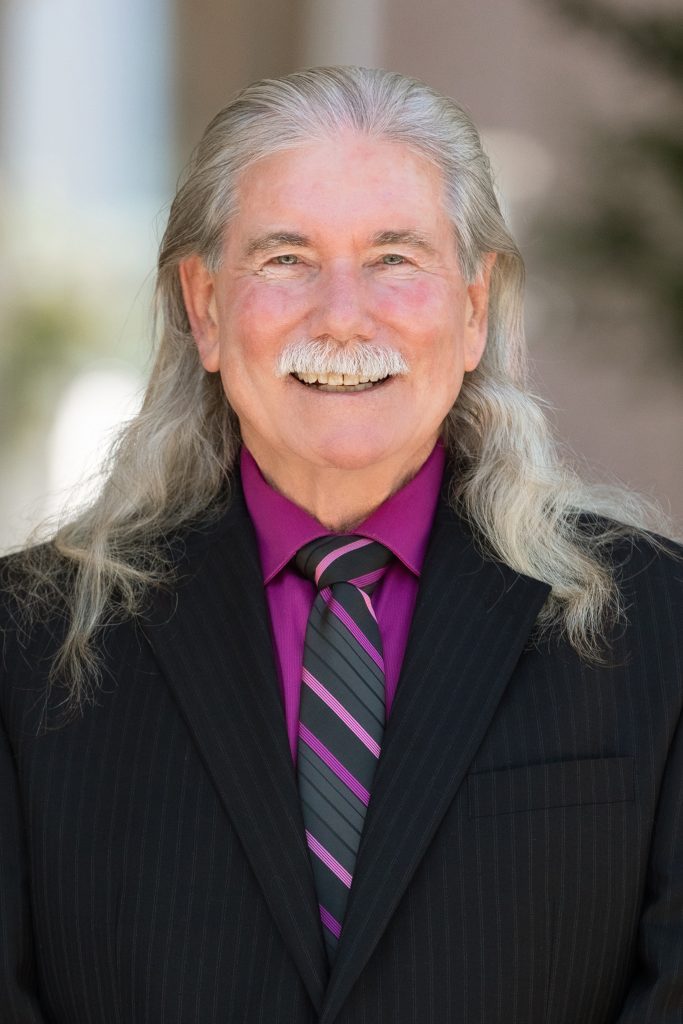
Judge Robert L. Jackson practiced law in Idaho from 1983 until going on the bench as a magistrate in Payette County in August 2013. His varied practice included criminal prosecution, criminal defense, assistant city attorney, personal injury (plaintiff and defense), medical malpractice, insurance law, and workers’ compensation. Judge Jackson also serves as the current Idaho State Bar President of the Board of Commissioners, representing the Third and Fifth Districts. When not engaged in legal work you can find him, with family members or friends, at a concert, hiking, backpacking, farming, or traveling.

Logan Graham is a second-year student at the University of Idaho College of Law. Logan earned his bachelor’s degree in history from Idaho State University and his associate’s degree in political science from the College of Western Idaho. His interests in law include constitutional law, land use, and personal injury.
[i] Religion and the Founding of the American Republic, Libr. of Cong. (last visited Apr. 27, 2026), https://www.loc.gov/exhibits/religion/rel06.html.
[ii] Religion in Colonial America: Trends, Regulations, and Beliefs, Facing Hist. and Ourselves (Mar. 14, 2016), https://www.facinghistory.org/resource-library/religion-colonial-america-trends-regulations-beliefs.
[iii] The Establishment Clause and Free Exercise Equality: In Bladensburg Cross Case, the High Court Partially Restores Founders’ View, Religious Freedom Inst. (June 24, 2019), https://religiousfreedominstitute.org/the-establishment-clause-and-free-exercise-equality-in-bladensburg-cross-case-the-high-court-partially-restores-founders-view/.
[iv] Lee v. Weisman, 505 U.S. 577, 589 (1992).
[v] Zorach v. Clauson, 343 U.S. 306, 314 (1952).
[vi] Elizabeth Katz, Founders Designed Establishment Clause to Protect Religion, McConnell Says, Univ. of Va. Sch. of Law (Oct. 31, 2005), https://www.law.virginia.edu/news/200510/founders-designed-establishment-clause-protect-religion-mcconnell-says.
[vii] Everson v. Bd. of Educ., 330 U.S. 1, 16 (1947) (internal citations omitted).
[viii] Idaho Const. art. XXI, § 20.
[ix] Id. art. I, § 4.
[x] Id.
[xi] Id. art. IX, § 5.
[xii] Id. art. IX, § 6.
[xiii] Phil McGrane, Foreword to the Idaho Const. Celebration Ed. (2026).