
THE LEGACY WE BUILD WHEN YOU INVEST IN MOCK TRIAL
By Carey Shoufler
In May, I received the Justice Gene Franchini Golden Gavel Award at the National High School Mock Trial Championship. The Golden Gavel is the highest honor the national program gives to someone who has contributed significantly to mock trial. I’m genuinely humbled to have received this honor. But I’m also aware that an award can provide a platform that is larger than any person being honored, so I want to use that platform to make a case about the importance of mock trial.
When Diane Minnich, former Executive Director of the Idaho State Bar, asked me to become Idaho Law Foundation’s Law Related Education Director, I said no. Three times. I was doing communications work for the Foundation, and while I respected the program, it wasn’t what I had signed up for. I was a high school English teacher by training, not a civic education specialist. I didn’t know anything about running a mock trial program and I wasn’t confident I was the right person for the job.
But, Diane was persistent. She had this way of asking again that made it clear she wasn’t really asking. So I finally said yes. That was 21 years ago. Diane, if you’re reading this: you may have known something I didn’t. It turns out you talked me into the best job I’ve ever had.
Ultimately, I decided to say yes to the Law Related Education Director position because I believe education in general, and civic education specifically is one of the most powerful investments anyone can make. What I’ve long known is how young people can grow when you trust them with complex material. And what I’ve come to understand is that mock trial is not just about teaching students to be lawyers. It’s about giving them permission to be bold. How to own their critical thinking skills. How to communicate with conviction. It’s about the legal profession and at the same time much bigger than the legal profession.
For the past two decades I have watched young men as freshmen, wearing suits that were borrowed or bought too big because someone said, “Don’t worry. You’ll grow into it.” And they do. By senior year, the suit fits. The posture changes. The voice steadies. The suit didn’t change. They did. Mock trial works a lot like that. At first, everything feels oversized—the courtroom, the language, the moment. And then, over time, the students grow into it.
I have watched young women walk into courtrooms already knowing that however they argue, it may come with a cost their male counterparts don’t pay. Too forceful and they’re difficult. Too soft and they’re overlooked. Mock trial gives them a place to stop editing themselves and learn what conviction sounds like when it’s not being managed for someone else’s comfort. What emerges, over and over, is something they didn’t know was in them. They plant their feet. They own their arguments. They find steady ground and don’t give it back.
And it isn’t only future lawyers who find their way into this program. Idaho’s program also offers courtroom artist and journalist contests. These participants would likely never see themselves stepping behind a podium but they can draw what they observe, or write what they witness, with precision and insight. Different skills. The same civic foundation. The same lesson: the legal system is not a mystery that belongs to someone else. It belongs to them.
Nationally, an estimated 43,500 students participate in mock trial programs across all 50 states every year. Research consistently shows that participation increases both students’ understanding of civic processes and their demonstrated critical thinking and argumentation skills. In Idaho alone, 325 students from 40 schools participated last year. They were coached and judged by 180 volunteers who collectively gave more than 1,500 hours of their time. At even a conservative billing rate, that’s roughly half a million dollars in donated professional expertise. In one season. In one state.
Multiply that investment by 21 years. Multiply it by every courtroom where a student walks in unsure what they’ve gotten themselves into and walks out indelibly changed. That is what this program does. It invests in students, in communities, in the legal profession’s own future.
Idaho makes this argument especially urgent. Our state has pockets of legal deserts with no attorneys or too few attorneys, serving populations that can’t readily access legal help. The young people growing up in those communities often don’t see the law as something that feels accessible or relevant to them.
And this isn’t only a rural challenge. We should invest in mock trial in every corner of this state—for urban students, homeschool groups, and students who haven’t found their place in traditional extracurriculars. It is a program for every kind of community and every kind of student. Education is upstream justice.
A student who participates doesn’t just learn about the legal system. She learns that she can navigate it. That it is not something that happens to her but something she can participate in, advocate through, and even build a career around, possibly right back in the community she grew up in.
I know what you’re thinking. You went to law school to provide legal services. The pull toward pro bono legal work makes complete sense. It is a direct expression of everything the profession stands for. Direct service is urgent, concrete, and immediate. Someone’s housing, custody, or livelihood is on the line. How do you weigh that against a high school competition? You don’t have to. That’s not the choice.
The legal profession rightly devotes enormous energy to direct services; to standing beside people in their most vulnerable moments. That work is essential and it should be celebrated. Pro bono legal services catch people when they fall. Law related education is what we build so fewer people fall in the first place.
You cannot cultivate a healthy respect for the rule of law on intervention alone. That foundation gets established through programs like mock trial, that, like pro bono legal services, is grounded in the professional belief that the law should be accessible, understood, and trusted by the people it’s meant to serve.
Programs like mock trial tend to do their work without drawing a lot of attention to themselves. Program staff show up year after year, quietly constructing something that takes a long time to see. That’s admirable. But programs that don’t draw attention to themselves are also easy to overlook and easy to undervalue. The work doesn’t need less visibility. It needs more champions. Think about it this way: many of us worry about diminishing trust in institutions when we can invest in teaching students how those institutions work in the first place.
So here is my ask. Three things. Pick one. Or more if you are so inclined.
Give time. Judge a round, coach a team, show up at a competition and watch what these students can do. If you can help a teacher in a rural or underserved community launch a program, do that. Ten additional schools with ten attorneys or firms willing to adopt a team or help a teacher get started would put mock trial in front of roughly 100 more Idaho students. That’s 100 more young people experiencing the legal system in a positive way. The math isn’t complicated.
Give money. Encourage your firm or organization to treat mock trial and other law related education as a genuine budget priority rather than a courtesy line item. The attorneys who already volunteer have collectively demonstrated what this work is worth. Resourcing it properly means it can reach further, last longer, and serve students who currently don’t have access to it.
Advocate. Talk about mock trial the way you talk about the work that matters to you. Because it does matter, and the more voices in the legal community that say so, the harder it becomes to treat as optional. Mention it at bar association meetings. Bring it up when civic education comes up. Tell a colleague. Tell a client with a student who needs a place to belong. Advocacy costs nothing and reaches everywhere.
The rule of law is not self-sustaining. We teach it or we risk losing it. And right now, in this particular moment in history, I would argue we have never needed to teach it more urgently or more intentionally than we do today.
The award I received is named for a man who loved the law, loved young people learning it, and never stopped saying so. His legacy is the award that bears his name. I’d like to think mine will be something maybe a little quieter but hopefully equally important. I have worked to be part of helping young people experience what it’s like to speak up and be heard. These are generations of students who learned something about themselves and their capabilities, and who left with a deeper respect for the rule of law.
Programs outlast the people who work to build them. That’s the whole point. I have spent 21 years being grateful that someone didn’t take no for an answer. Don’t let mock trial keep working quietly in the background, uncertain whether there’s space for this important program. Be part of a legal legacy that makes room.
Add Your Heading Text Here
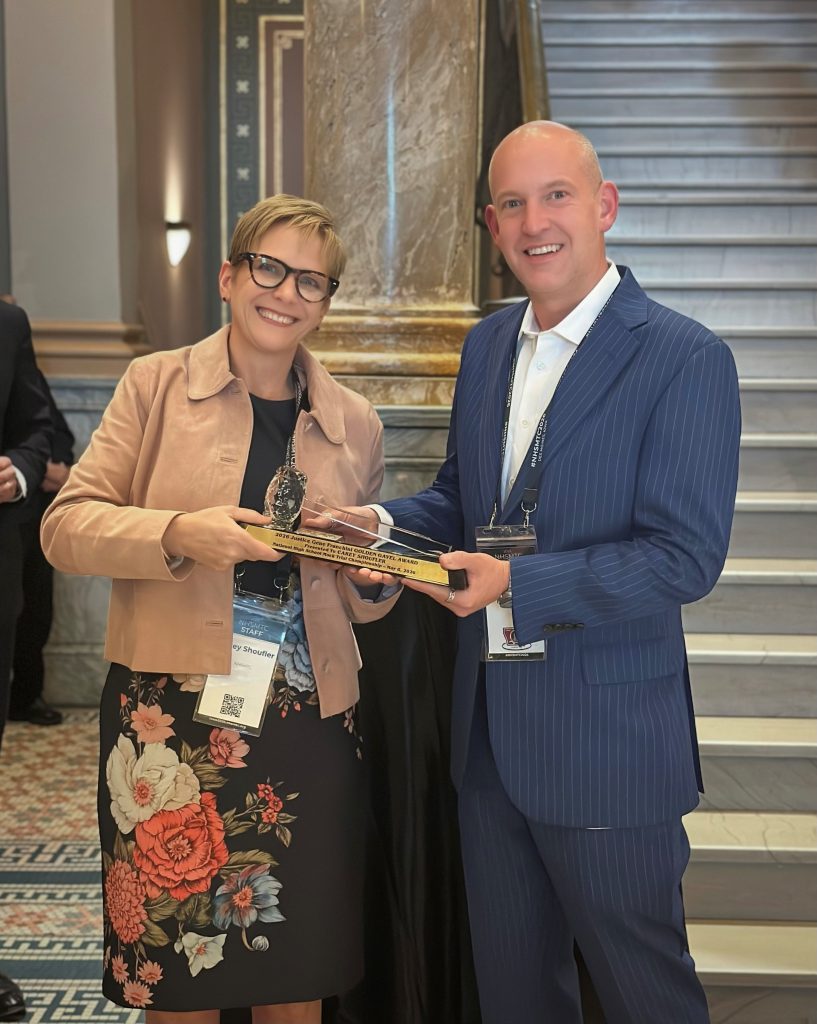
Carey Shoufler For nearly 40 years, Carey Shoufler has worked in education in an array of settings. In her current role, Carey has spent the last 21+ years working as the Law Related Education Director for the Idaho Law Foundation.
Carey utilizes her experience as an educator to provide leadership and management for a statewide civic education program with a goal of fostering successful partnerships between the legal community and the public to help Idaho citizens better understand of the Rule of Law.
Carey obtained her bachelor’s degrees in English literature from Mills College in Oakland, California and her master’s degree in instructional design from Boise State University. A native Idahoan, Carey returned to Boise in after working for 13 years as a teacher and educational administrator in Boston.
Carey recently received the Justice Gene Franchini Golden Gavel Award. This award is given out by the National High School Mock Trial Championship in recognition of a mock trial leader who has demonstrated exemplary dedication and commitment to the goals and ideals of the national high school mock trial program.