
Five Impactful Changes to Child Protection Law from the 2025 Legislative Session by Hon. Andrew N.J. Ellis

The 2025 Idaho Legislative Session generated at least six bills affecting Idaho’s child welfare system. The following are five statutory additions or amendments that every Child Protection practitioner and judge should be aware of.
Additional Review Hearings and Accelerated Timelines
Senate Bill 1090 made several significant changes to the Idaho Child Protective Act
[i] “intended to decrease the time children spend in foster care . . . and to increase the time these children spend in supportive, permanent homes.”[ii] One change is aimed at expediting either reunification for a child with their family or placement in another permanent home by increasing court reviews and accelerating timelines. Senate Bill 1090 amends Idaho Code § 16-1622 (1)(a) to read in pertinent part: “A hearing for review of the child’s case and permanency plan shall be held no later than six months after entry of the court’s order taking jurisdiction under this act and every two months thereafter.” (amendment in italics). In practice, this change means that once a Child Protection case reaches the six-month mark, a subsequent two-month review hearing must be held at eight months, ten months, twelve months, fourteen months, and so on until the case is closed. This obligation to conduct a hearing every two months attaches to all cases even if termination of parental rights has occurred or if the youth is in extended foster care (EFC).
The purpose of all review hearings is to determine the safety of the child, the continuing necessity for and appropriateness of the placement, the extent of compliance with the case plan, the progress toward mitigating the need for ongoing placement in foster care, and all the articulated requirements of I.C. § 16-1622. The Department of Health and Welfare (Department) and the Guardian ad litem (GAL) are required to file reports to the court for all review hearings no later than five days prior to the hearing. The reasoning behind the additional review hearings is that more focus on progress toward permanency will result in achieving permanency more quickly.
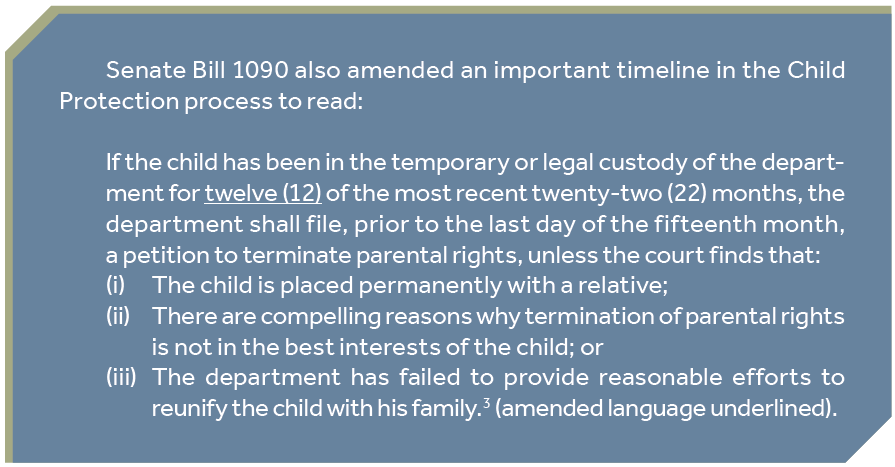
This substantive change accelerates the timeline within which the Department must file a petition for termination of parental rights to a child in the legal custody of the Department from fifteen months to twelve months of the most recent twenty-two months.[iii] In practice, this amendment means that if a child remains in the legal custody of the Department when the Permanency Hearing is held at 12 months, the Department must request termination of parental rights as the permanency goal. Additionally, the Department must file a petition to terminate parental rights prior to end of 15 months unless the court finds “compelling reasons” why termination of parental rights is not in the child’s best interest.[iv]
Extended Foster Care Until Age 23
Idaho Code § 16-1622(5) previously authorized the courts to extend care for foster youth until their 21st birthday if the youth met certain federal criteria of on-going education or more than part-time employment.[v] House Bill 159 amended I.C. § 16-1622(5) to expand extended foster care for foster youth until their 23rd birthday.
EFC provides youth with on-going case management from the Department, payments for the youth’s room and board, and continued access to Department independent living resources and education. To qualify for EFC, a youth must be in the legal custody of the Department until their 18th birthday and be completing their secondary education or equivalent credential, enrolled in post-secondary or vocation education, employed for at least 80 hours per month, or be incapable of doing any of those activities due to a medical condition. The youth must also remain living in Idaho to qualify for EFC.[vi]
New “Order to Prevent Removal”
House Bill 159 removes all mention of a “protective order” process from Title 16, Chapter 16 and adds a new option for the State and Department to protect children from a neglectful or abusive parent.
Previously, the “protective order” process was identified and referenced in at least six places within the Child Protective Act.[vii] These code sections were internally inconsistent with differing burdens of proof, making it impractical to utilize this tool in Child Protection cases. House Bill 159 struck all references to “protective order,” ending this confusion.
In its place, HB 159 creates a new tool in I.C. § 16-1611 (5) called an “Order to Prevent Removal.” If the State becomes aware through the Department or law enforcement that a child has been abused or neglected by one parent or legal guardian, but the child would be safe in their home in the sole care of the other parent or legal guardian, the State can petition the court for an “Order to Prevent Removal.” The order removes and excludes the offending parent from the residence where the child resides with their other protective parent, restrains the offending parent from any contact or communication with the child, and restrains that parent from coming within 1,500 feet of the child until further order of the court.
An “Order to Prevent Removal” must be filed in a Child Protective Act case, so the motion for such an order must be accompanied by a Petition and Summons initiating a Child Protective Act case. If an “Order to Prevent Removal” is granted, the court shall schedule a hearing within 48 hours, excluding weekends and holidays, to determine if there is reasonable cause for the order to continue. This hearing is not a Shelter Care Hearing, which is held within 48 hours of a child’s removal, because the child has not been removed into foster care. If the “Order to Prevent Removal” remains in place after the initial hearing, the child will stay with the non-offending parent or legal guardian until an Adjudicatory Hearing is heard by the court.
The intention of this new statutory tool is to protect a child from a neglectful or abusive parent but avoid traumatizing the child by removing them into foster care. Note this option is only available if their other parent is safe and capable of protecting the child from the offending parent.
“The reasoning behind the additional
review hearings is that more focus on
progress toward permanency will result
in achieving permanency more quickly.”
Voluntary Consents to Termination of Parental Rights and New Best Interest Factors
Perhaps the most profound changes to the Child Protective system from the 2025 Legislative Session are those modifications to the Termination of Parental Rights statute in Senate Bill 1021 and 1090.
One change relates to allowing parents who agree that terminating their parental rights is in their child’s best interests,[viii] to voluntarily consent to termination of their parental rights. S.B. 1021 amended I.C. § 16-2005 (5) to read:
The court may grant an order terminating the relationship where a consent to termination in the manner and form prescribed by this chapter has been filed by the parent or parents of the child in conjunction with a petition for adoption initiated by the person or persons proposing to adopt the child, where the consent to termination has been filed by a licensed adoption agency, or where the termination is initiated by the department pertaining to a child who is in the legal custody of the department, and no subsequent hearing on the merits of the petition shall be held. Consents required by this chapter must be witnessed by a district judge or magistrate of a district court, or equivalent judicial officer of the state, where a person consenting resides or is present, whether within or without the county, and shall be substantially in the following form…
(Amended language underlined.) Senate Bill 1021 further amended I.C. § 16-2005 (8) to add subsection (c), which reads:
The court shall hold a hearing unless:
…
(c) A consent to termination signed by the parent or parents of the child has been filed and the termination is initiated by the department pertaining to a child who is in legal custody of the department.
Together, these new code sections allow parents with children in the legal custody of Department to voluntarily consent to termination of their parental rights. Furthermore, once a court witnesses a properly executed consent from the parents, the court can issue an order to terminate parental rights without a further hearing on the merits or a trial on the State’s petition. This change is profound in that it allows parents greater dignity to make this ultimate decision regarding their children and accelerates placement of Idaho’s foster children into adoptive homes, rather than waiting months or even years for termination of parental rights trials to be scheduled and for appeals from those trials to be heard. Additionally, the savings in time and money for the State and court system in avoiding protracted contested trials and writing lengthy opinions is immense.
Another change is the specification of circumstances that must be considered in the determination of what is in the best interest of a child in addition to those identified in the existing caselaw. Should a trial on a petition for termination of parental rights prove necessary, S.B. 1090 amends I.C. § 16-2005 (1) to add a new subsection (b) that reads:
(b) For terminations arising from a case filed pursuant to chapter 16, title 16, Idaho Code, additional factors that inform what is in the best interest of the child, beyond those otherwise identified by the courts, include:
(i) The parent’s efforts to improve the parent’s capacity to safely reunify with the child;
(ii) The parent’s demonstrated ability to live a law-abiding life, excepting infraction violations; and
(iii) When the child has formed a strong and positive bond with the child’s substitute caretaker, the strong and positive bond has existed for a substantial portion of the child’s life, the removal of the child from the substitute caretaker would likely cause serious psychological harm to the child, and the parent lacks the capacity to meet the needs of the child upon removal.
To terminate parental rights, the State must prove by clear and convincing evidence—or beyond a reasonable doubt if the Indian Child Welfare Act applies—that (1) conditions exist to terminate parental rights and (2) termination of parental rights is in the child’s best interest.[ix] Idaho’s appellate courts have identified a number of factors the court can consider in determining whether termination of parental rights is in a child’s best interest, including stability and permanency in the home, unemployment of the parent, improvement of the child while in foster care, the parent’s continuing problems with the law, the parent’s history with substance abuse, and whether the parent has provided financial support. Idaho Code § 16-2005(1)(b)(i)-(iii) provides specific statutory support for courts to consider whether the parents have improved their capacity to safely reunify and if they have demonstrated the ability to live a law-abiding life.
Most substantial, the amendment allows the court to consider whether a child has formed a strong bond with their long-term foster parents and if removal of the child from their foster parents would cause serious psychological harm to the child. Previously, there was some question whether it was proper for the courts to consider the attachment children had formed with their long-term foster parents in deciding whether termination of the legal parents or guardians’ right was in the children’s best interest. This statutory amendment makes it explicit that courts can and should consider that dynamic.
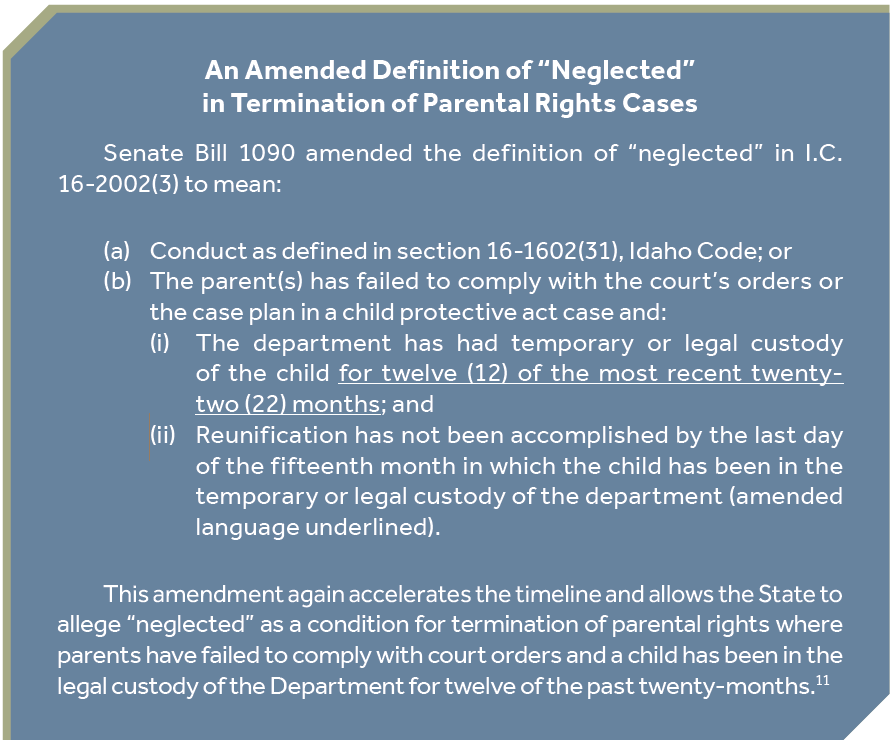
An Amended Definition of “Neglected” in Termination of Parental Rights Cases[x]
Conclusion
Together, these five impactful changes touch on all aspects of a Child Protective case. With the new “Order to Prevent Removal” the State can intervene on behalf of a child without exposing them to the trauma of a removal into foster care. Once a Child Protective Act case is open and lasts longer than six months, the courts must conduct review hearings no later than every two months to closely monitor progress by the children and their parents. If children cannot be reunified with their parents within twelve months, the Department must petition the court to terminate parental rights. Should a parent agree that termination of their parental rights is best for their children, they now can voluntarily consent to termination of their rights, forgoing the need for a further hearing or trial that will certainly delay their child’s placement into a permanent home. If a trial is required, the court may now specifically consider the bond that child has formed with their long-term caregiver. These statutory amendments to Idaho’s Child Protection system prioritize the children’s wellbeing and improve court processes to support Idaho’s families.

Hon. Andrew N.J. Ellis is a Magistrate Judge for the Fourth Judicial District in Ada County assigned to the Child Protection and Civil Protection Order calendar. He is the Chairperson of the Idaho Supreme Court Child Protection Committee and an Adjunct Faculty member for the University of Idaho College of Law.
[i] I.C. § 16-1601 et. seq.
[ii] RS32251/S1090, Statement of Purpose.
[iii] Of note, the amendment does not appear to have been carried through to other related provisions, resulting in a discrepancy between the timeline that triggers this requirement (twelve months in the legal custody of the Department) and the timeline for when the petition must be filed (prior to the last day of the fifteenth month). This discrepancy will likely be corrected in the 2026 legislative session.
[iv] The prior requirement of fifteen months out of the most recent twenty-two months is the time frame required under the Adoption and Safe Families Act (1996), also enacted to expedite permanency for children in foster care.
[v] 42 U.S.C. 675(8)(B)(iv).
[vi] Of note, when a court orders EFC, the court shall hold hearings in accordance with Idaho Code § 16-1622, which now requires hearings every two months. Appointments of the youth’s attorney continue throughout EFC but the Guardian ad litem’s appointment expires at the youth’s 18th birthday. Idaho Juvenile Rule 59.
[vii] Prior I.C. §§ 16-1602(34), 16-1608(1)(b), 16-1608(2), 16-1611, 16-1615, and 16-1619(10).
[viii] There are many reasons parents agree that termination of their parental rights are in their child’s best interest, such as they are not able to provide a stable home for many reasons, including their own struggle with addiction, mental health, incarceration, etc., and that their child is doing well in a home that is willing to become the child’s permanent placement.
[ix] See generally I.C. §§ 16-2005, 16-2009.
[x] The same discrepancy exists in this statute as in I.C. § 16-1622(2)(g) – the timeline regarding months the child has spent in custody is twelve months but the second half of the definition regarding lack of reunification with the parent still cites fifteen months. In practice, this means the State cannot prevail in proving this condition of “neglect” until the Child Protection case is at least fifteen months old. This discrepancy, too, will likely be corrected in the 2026 legislative session.