
Commissioner’s Column: This Veterans Day, It’s Time to Get Serious About Discharge Upgrades

I have a friend named Danny.
That is not his real name. At his request, I have changed his name and certain identifying details, but the important parts of his story are true.
Danny is an American hero.
He enlisted in the Delaware Army National Guard in 2007, serving with the 198th Signal Battalion before transitioning to active duty in 2009.
And then came Afghanistan.
From 2009 to 2010, Danny served in Bagram and Gardez, Afghanistan, supporting the 82nd Airborne Division. After returning to Fort Hood and the 57th Signal Battalion, he deployed again—this time to Kandahar from 2011 to 2012.
He later served with the 25th Infantry Division at Schofield Barracks, Hawaii.
Calling Danny a hero should not be controversial.
We Americans love calling our veterans heroes.
Leaders from both political parties do it. President Barack Obama spoke of veterans as “our nation’s heroes.” Vice President Mike Pence once declared that “every veteran” of our Armed Forces is a hero. President Joe Biden praised the “absolute heroism” of those who fought at Normandy.[1]
Our music does it too. Toby Keith sang about the American Soldier. Lee Greenwood made an entire generation proud to be American. Country singers have built careers around soldiers, sacrifice, flags, and coming home.[2]
Every November, we say the words again.
We thank veterans for their service. Restaurants give away meals. Businesses offer discounts. Politicians give speeches.[3]
But there was something else on Danny’s military record.
Danny received an Other Than Honorable (OTH) discharge.
And suddenly, the word hero becomes more complicated.
We Have Been Here Before
Danny’s story is not unique to the wars in Iraq and Afghanistan.
We just used different words after earlier wars.
During World War I, it was “shell shock.” By World War II, the military spoke of “battle fatigue” or “combat stress reaction.” Today, we recognize many of those symptoms as manifestations of post-traumatic stress disorder (PTSD).[4]
Whatever terminology we use, the underlying problem is ancient:
War does things to people.
Vietnam made that painfully clear.
Drug use among American servicemembers in Vietnam became so widespread that, in 1971, the military began testing servicemembers for drugs before allowing them to return home. One landmark study found that nearly half of the Army enlisted men in its general sample had tried narcotics while in Vietnam, and 20 percent reported opiate addiction.[5]
The military’s response was not simply punishment. By 1971, military exemption programs offered treatment and limited protection from prosecution to certain servicemembers who voluntarily sought help. That August, the Secretary of Defense directed review of certain earlier administrative OTH discharges based solely on personal drug use or possession for personal use.[6]
More than fifty years ago, the military was already grappling with a question we still struggle with today:
When is misconduct simply misconduct, and when is misconduct evidence that someone needs help?
The Invisible Wounds of Our Wars
Decades later, Danny went to Afghanistan.
Twice.
Like many veterans who served during the worst years of the wars in Afghanistan and Iraq, Danny came home carrying things that did not appear on his DD-214.
Eventually, he began using drugs.
That sentence is easy to write from the comfort of a law office. It is considerably harder to understand everything that came before it.
For generations of servicemembers, seeking mental-health treatment has carried a stigma. Servicemembers worried about their careers, their units, their commanders, their security clearances, or simply being viewed as weak.[7]
So some servicemembers do what human beings have always done when they are hurting and do not know how—or do not believe they are permitted—to ask for help.
They self-medicate.[8]
Eventually, the military sees the misconduct.
But sometimes it misses the injury underneath it.
Danny received an Other Than Honorable discharge.
He is far from alone.
A Government Accountability Office study examined 91,764 servicemembers separated for misconduct between fiscal years 2011 and 2015. Sixty-two percent had been diagnosed during the preceding two years with PTSD, traumatic brain injury, or certain other mental-health conditions potentially associated with misconduct.
More than 13,000 servicemembers in the study who had one of those diagnoses nevertheless received an Other Than Honorable discharge.[9]
Sometimes the thing for which we punish a servicemember may be a symptom of the thing we should have been treating.
More Than a Line on a Form
An OTH discharge is not just an unfortunate phrase on a piece of paper.
For some veterans, it can stand between them and VA health care or disability compensation.
That does not mean every veteran with an OTH is ineligible. The VA can make its own favorable character-of-discharge determination without a military upgrade, and certain care may be available even without enrollment in VA health care. Veterans should not assume the door is closed.[10]
Education benefits have their own rules. The Post-9/11 GI Bill generally requires an Honorable discharge from the qualifying period of service. An upgrade can help an otherwise eligible veteran access money for tuition, housing, and books.[11]
Employment can be affected, too. Federal veterans’ preference generally requires an Honorable or General Under Honorable Conditions discharge, along with other eligibility requirements. An OTH can mean losing that advantage. Outside government, the stigma can also complicate a veteran’s job search.[12]
An upgrade does not guarantee benefits or a job. But it can remove barriers that have followed a veteran for years.
Not Every Benefit Comes With a Dollar Sign
But some veterans are not looking for a benefits check or a new job.
They may already have health insurance. They may be retired. The practical effect of an upgrade may be limited.
That does not make it meaningless.
For some, an OTH can feel less like a description of how their service ended and more like a judgment on who they are.[13]
They served. They sacrificed. But the document they carried home seems to tell them that none of it counted.
An upgrade cannot undo everything that happened. But it can acknowledge that the worst chapter of someone’s life is not the whole book.
And we should take the mental-health stakes seriously.
A 2025 study of more than 3.6 million people leaving the military’s active component found that, after accounting for age, those with OTH discharges had about 2.5 times the suicide rate of those with Honorable discharges in the first five years after separation.
That does not prove the discharge caused those deaths, or that an upgrade would have prevented them.[14]
But it is a reminder that we are talking about people, not just paperwork.
Discharge Upgrades
The good news is that the characterization written on a DD-214 is not necessarily the end of the story.
Federal law provides veterans a mechanism to ask that their military records—and, in appropriate cases, their discharge characterization—be changed.[15]
Generally, veterans discharged within the previous 15 years may apply to their service’s Discharge Review Board using DD Form 293. Older cases, and cases involving broader corrections to military records, generally proceed before the appropriate Board for Correction of Military or Naval Records using DD Form 149.[16]
On paper, the process looks deceptively simple. A veteran fills out a form.
But the veteran does not have to submit only the form.
An application can include medical and mental-health records, service records, VA records, statements from fellow servicemembers and family members, evidence of rehabilitation, and, critically, the veteran’s own narrative.[17]
That is where lawyers can help.
Lawyers Tell Stories
Think about what we do for a living.
Clients bring us years of documents, experiences, mistakes, and circumstances. We ask questions. We identify the legally significant facts. We gather evidence. Then we organize those facts into a story another person can understand.
A discharge-upgrade case may begin with:
Danny used drugs. Danny got in trouble. Danny received an OTH.
But that is not the whole story.
Danny enlisted.
Danny served.
Danny deployed to Afghanistan.
Danny came home.
Danny deployed again.
Danny struggled.
Danny used drugs.
Danny got in trouble.
Danny received an OTH.
The misconduct has not disappeared.
It has context.
A lawyer can help connect medical evidence to the timeline, obtain statements from people who knew the veteran before and after deployment, explain how PTSD, traumatic brain injury, addiction, or another condition may have contributed to the misconduct, and document the veteran’s life since leaving the service.[18]
That is advocacy.
And we already know how to do it.
Ask the Question
Most Idaho attorneys will never practice military law.
That does not matter.
Veterans are our estate-planning clients. Our criminal-defense clients. Our family-law clients. Our employees. Our neighbors. Our friends.
And some have carried an unfavorable characterization of their military service for decades, believing there is nothing they can do about it.
So this Veterans Day, I am asking Idaho attorneys to add one question to the conversations they are already having:
“Were you—or someone you know—discharged from the military with anything other than an Honorable discharge?”
If the answer is yes, ask another:
“Have you ever looked into having it upgraded?”
The Idaho State Bar has an excellent place to start. In 2022, the Young Lawyers Section and Fourth District Bar presented Military Discharge Upgrades: One Way to Help Our Veterans, a free one-hour CLE taught by Margaret R. Kuzma of Harvard Law School’s WilmerHale Legal Services Center. The program remains available—for free—through the Idaho State Bar’s online CLE library.[19]
You do not need to become a military-law expert. You need to know how to listen to a client, gather evidence, understand the applicable standard, and tell a story.
You are already trained to do that.
Back to Danny
I want to go back to Danny, because something changed between the time I started writing this article and the time I finished it.
Long before I started writing, I helped Danny put together a discharge-upgrade packet. Updated medical records. Treatment records. Personal statements. Character references.
The documents that helped tell the rest of his story.
He sent it in.
And we waited.
And we waited.
And we waited.
Two and a half years after he submitted that packet, a certificate arrived in the mail:
“Honorable Discharge from the Armed Forces of the United States of America.”
His service had not changed. Neither had the things he struggled with when he came home.
What changed was the government’s recognition of that service.
Danny was always an American hero.
But we already knew that.
Now Uncle Sam knows it, too.
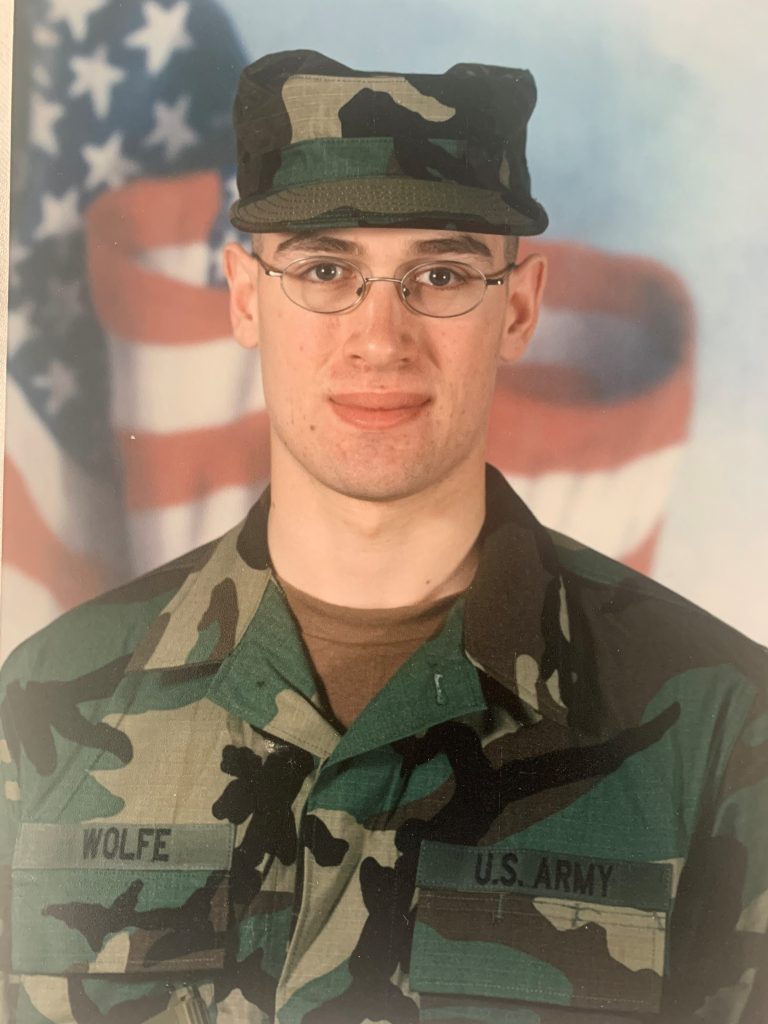
Matthew Wolfe enlisted in the New Jersey Army National Guard in September 2003. He completed basic training at Fort Leonard Wood, Missouri, and Advanced Individual Training at Fort Huachuca, Arizona, before deploying to Guantanamo Bay, Cuba. Since becoming an attorney, Matt has continued his commitment to serving those who served, including as President of the Idaho Military Legal Alliance, where he has advocated for veterans and expanded access to legal assistance. He currently practices estate planning and probate law at Twin Falls Estate Planning.
Endnotes
[1] Barack Obama, Remarks by the President on Veterans Day (Nov. 11, 2011); Mike Pence, Remarks at the Department of Veterans Affairs’ National Veterans Day Observance (Nov. 11, 2019); Joe Biden, Remarks at the National Veterans Day Observance (Nov. 11, 2024). Official White House archives.
[2] Toby Keith, Toby Keith’s “American Soldier” Gets High Gloss Shine (July 3, 2020); Lee Greenwood, Lee Greenwood Celebrates 40th Anniversary of Timeless Anthem “God Bless the U.S.A.” (May 20, 2024). Official artist websites.
[3] See, e.g., Applebee’s, Applebee’s Honors Veterans & Active Duty Military with Free Meals on Veterans Day (Oct. 27, 2025); U.S. Department of Veterans Affairs, Veteran & Military Year-Round Discounts. These are examples of the tradition, not a list of announced 2026 offers.
[4] Matthew J. Friedman, History of PTSD in Veterans: Civil War to DSM-5, U.S. Department of Veterans Affairs, National Center for PTSD.
[5] Lee N. Robins, John E. Helzer & Darlene H. Davis, Narcotic Use in Southeast Asia and Afterward: An Interview Study of 898 Vietnam Returnees, 32 Archives of General Psychiatry 955, 955–61 (1975), doi:10.1001/archpsyc.1975.01760260019001. For the 1971 return-home testing program, see U.S. General Accounting Office, Drug Abuse Control Program Activities in Vietnam, B-164031(2), at 19–24 (July 1972).
[6] U.S. General Accounting Office, Drug Abuse Control Program Activities in Vietnam, B-164031(2), at 27–29 (July 1972); Secretary of Defense, Review of Discharges Under Other Than Honorable Conditions Issued to Drug Users (Aug. 13, 1971), reproduced in 32 C.F.R. pt. 724, app. A. The August directive covered qualifying administrative discharges finalized or in process on or before July 7, 1971.
[7] Charles W. Hoge et al., Combat Duty in Iraq and Afghanistan, Mental Health Problems, and Barriers to Care, 351 New England Journal of Medicine 13, 13–22 (2004), doi:10.1056/NEJMoa040603; Defense Counterintelligence and Security Agency, Mental Health and Security Clearances (Apr. 2024). Seeking mental-health treatment itself does not bar security-clearance eligibility.
[8] U.S. Department of Veterans Affairs, National Center for PTSD, Substance Use and PTSD (AboutFace).
[9] U.S. Government Accountability Office, DOD Health: Actions Needed to Ensure Post-Traumatic Stress Disorder and Traumatic Brain Injury Are Considered in Misconduct Separations, GAO-17-260, at 12–15 (May 2017). The 62 percent includes specified mental-health conditions beyond PTSD and TBI; 13,283 members with a qualifying diagnosis received OTH discharges. The figures establish diagnoses, not causation in each individual case.
[10] U.S. Department of Veterans Affairs, Applying for Benefits and Your Character of Discharge; What Benefits Can I Get If I Have an Other Than Honorable Discharge? (both last updated Apr. 16, 2025). VA eligibility determinations are separate from military discharge upgrades; certain care may be available without VA health-care enrollment.
[11] U.S. Department of Veterans Affairs, Compare VA Education Benefits, sections on character of discharge, service requirements, and payments. Other eligibility requirements apply; an upgrade alone does not establish entitlement.
[12] U.S. Office of Personnel Management, How Do I Determine If I Am Eligible for Veterans’ Preference?; Yale Law School, Veterans Legal Services Clinic, Kennedy v. McCarthy (describing employment barriers). Loss of preference is not a blanket prohibition on federal employment.
[13] See Yale Law School, Veterans Legal Services Clinic, Kennedy v. McCarthy (discussing the lasting stigma of less-than-Honorable discharges).
[14] Mark A. Reger et al., Character of Discharge From the US Military and Suicide Mortality, 8(5) JAMA Network Open e2512081 (2025), tbl. 2, doi:10.1001/jamanetworkopen.2025.12081.
[15] 10 U.S.C. § 1552 (correction of military records); 10 U.S.C. § 1553 (review of discharge or dismissal).
[16] See DD Form 293, Application for the Review of Discharge from the Armed Forces of the United States, instructions; DD Form 149, Application for Correction of Military Record, instructions (both Feb. 2025 editions, updated Aug. 12, 2026). Under 10 U.S.C. § 1553(a), DRB applications must be made within 15 years, and general-court-martial discharges are excluded. Under 10 U.S.C. § 1552(b), correction-board applications ordinarily must be filed within three years after discovery of the error or injustice; the board may excuse untimeliness in the interest of justice. DD Form 149 also directs applicants to exhaust available administrative remedies.
[17] DD Form 293, instructions; DD Form 149, instructions; A. M. Kurta, Clarifying Guidance to Military Discharge Review Boards and Boards for Correction of Military/Naval Records Considering Requests by Veterans for Modification of Their Discharge Due to Mental Health Conditions, Sexual Assault, or Sexual Harassment (Aug. 25, 2017), attachment, paras. 5–7.
[18] A. M. Kurta, Clarifying Guidance (Aug. 25, 2017), attachment, paras. 2, 18–19. The guidance addresses the connection between a condition and misconduct, including possible self-medication, while recognizing that serious misconduct can outweigh mitigation.
[19] Idaho State Bar, Military Discharge Upgrades: One Way to Help Our Veterans (Jan. 18, 2022), presented by Margaret R. Kuzma and sponsored by the Young Lawyers Section and Fourth District Bar Association; see also Free CLEs Offered for Live and On-Demand Credit. The on-demand course is listed at $0.00 for 1.0 CLE credit (accessed Sept. 24, 2026).