
From Territory to Statehood: Richard Z. Johnson, Founder of the Idaho State Bar Association, Early Author of the Idaho Code, and Legislative Sponsor of the Boise Independent School District by Mark Daly
Travel back in time to the late 1800s. Imagine you are standing in an office containing the massive personal law book collection, numbering 4,000 volumes, neatly shelved in the law office of Richard Zena Johnson – prominent jurist, legal scholar, prolific author, orator, and civic leader. Before your eyes appear, row upon row of leather-bound legal volumes, featuring each inside cover signed in distinctive, legible handwriting: Richard Z. Johnson.
The spine of each book reveals subject, dates and author containing case law and other contents dating back to 1650. The private collection reminds visiting judges, attorneys, and guests of a time when the source of legal precedent, opinions, and judicial rulings resided in these volumes, not in digital files domiciled in some remote corner of the country. The legal library contains proceedings and rulings from the U.S. Supreme Court, the Idaho Supreme Court, appellate courts, district courts and writings of numerous legal scholars. Highlights include Blackstone’s Commentaries and complete volumes of Idaho territorial law.
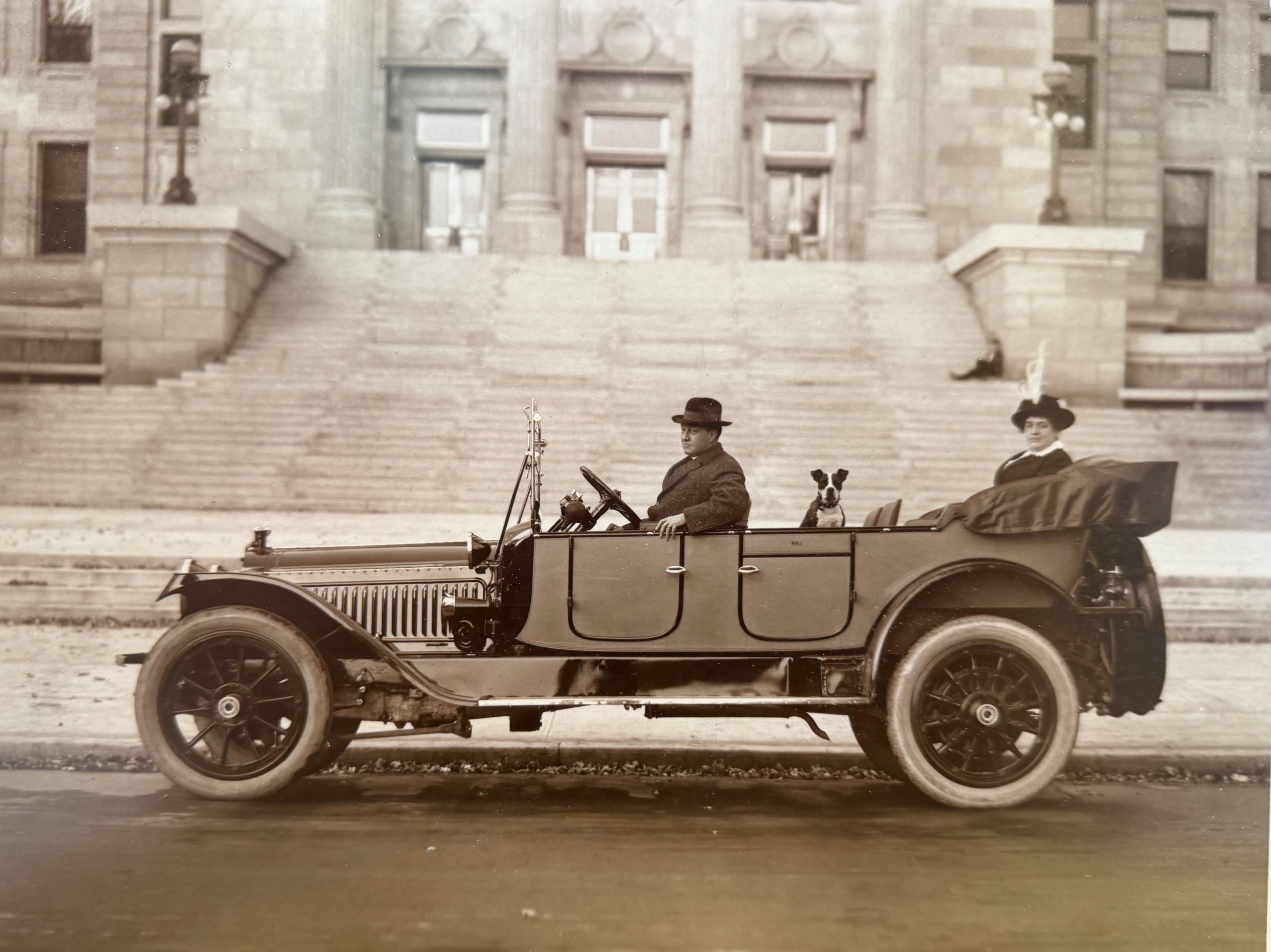
Each volume, leather bound, has affixed a small, personalized label that reads “Johnson,” “Johnson & Johnson,” and “Johnson & Nixon,” representing three generations of family members who practiced from 1885 to 1980. R.Z. Johnson had a son, Richard H. Johnson, also Yale educated like R. Z., who joined his father in the practice of law after graduation. The law office building and its contents survive intact after 140 years of continuous ownership by one family – a unique chapter in Idaho history, and a story worth telling.
Carey H. Nixon, Richard H. Johnson’s son-in-law who married Kathrina Johnson, was the last lawyer and relative to occupy the building. Carey Nixon hailed from a small town in Iowa and the two met at Stanford University. Nixon was a prominent attorney in Boise, passing the bar exam in 1921, and had built a diversified practice in corporate law, water rights and general business.
Tents to Towers: The History of the Practice of Law in Idaho (2025) contains at least fifteen printed mentions of Richard Z. Johnson.[1] Only Governor James H. Hawley is mentioned more frequently (26). On page 33 the featured sidebar shows the father sitting across the desk from his son, Richard H. Johnson, with the private book collection in the background. The photo is the most recognized image in the public domain, which was provided by the family to the Idaho State Historical Society. History buffs and preservationists will be delighted to learn that dozens of photos, artifacts, and personal belongings survive, remain in storage, and are cataloged for later display.
In the October 2010 edition, The Advocate published “The First 50 Men in Idaho Law.”[2] Johnson did not make the top 25, despite significant contributions during his 30-year legal career. Not everyone is a born politician, and R. Z. Johnson was no exception. His legacy suggests satisfaction in toiling in the background, applying impeccable wit, logic and critical thinking to problem solving, which was perhaps his greatest skill and most valuable contribution. His name does not appear on the lists of judges, magistrates, and governors in Tents to Towers.[3] Johnson’s list of accomplishments involved “doing” – an advocate, joiner, appointee and implementer, thereby earning respect from colleagues and adversaries alike.
The original single-room Johnson Law Office, built in 1885, is one of Boise’s earliest constructed and oldest surviving professional buildings. “It was easily the finest such building in the city,” wrote Arthur A. Hart, Director of the Idaho Historical Museum, in the Idaho Statesman on February 18, 1974.[4] Hart continued that “[t]he law library was long hailed as the finest collection in the state.” The construction suggests a commitment to Boise’s downtown development, including Johnson’s personal residence at the corner of Sixth and Main Streets, currently a law firm parking lot, plus apartments constructed on the Johnson Block eastward to Fifth Street.
The Idaho Architecture Project says architect James C. Paulsen, who hailed from Montana, designed the Old City Hall, Columbia Theater and Natatorium pool complex on Warm Springs Ave.[5] The Johnson Block was conceived as covering the entire block, but a fire and economic slump curtailed further construction. The former Davies Reid import business, now occupied by Ocho’s Patio and Dance Studio, “feature[s] two octagonal towers in the façade with picturesque dormers set at either end.” This structure is the only surviving building designed by Paulsen and still standing in Boise.
The Johnson Law Office Building is located within the Capitol Boulevard Design Overlay District, specifically in the Downtown Corridor, one of four district subareas. The corridor includes both sides of Capitol Boulevard from the centerline of Front Street north to the centerline of State Street.[6] The Johnson Law Office is afforded consideration and protection from future surrounding development. Constructed by local stonemasons, the foundation features irregular sandstone blocks quarried from the nearby Boise foothills according to records kept by the Johnson family. The red bricks were possibly manufactured by the Pullman Brick Co., formerly located on E. Warm Springs Ave. according to Kelly Troutner, local brick expert with extensive knowledge of historic structures. These “sand” style rough finish bricks feature prominently on three sides of the structure. “If not heated and kiln fired properly, the front pops off the brick, and they disintegrate when exposed to water” according to Troutner.
Higher quality “fancy bricks” front the west side facing Sixth Street, and present a more modern, stylish look. The bricks are glazed with a liquid coating prior to firing, creating a gloss finish. The building’s Greek Revival design creates a rectangular footprint on the property, and shotgun-style interior. One can view the interior length from the entrance on Sixth Street to the carriage house (now serving as a short-term vacation rental).
Five prominent large windows, arched using keystones, face north. Two matching windows on Sixth Street feature arched openings and tiny carved horse head keystones at the apex. Hand-built mortise-and-tenoned jointed window screens cover the interior operating window frames, which utilize sash cord attached to counterweights. This allows for ease when raising and lowering the imperfect “wavy” glass windows of the period.
Birth, Education, and Law School
Richard Zena Johnson was born in Akron, Ohio, in 1837 and received his early education in Ohio, Minnesota, and New York.[7] He later attended the United States Military Academy before pursuing studies at Yale Law School, where he graduated with a law degree in 1859.
After completing his law degree, Johnson was admitted to the bar in Minnesota and began practicing law in the Midwest. Johnson moved to Silver City in 1865 and practiced for a decade before relocating to Boise in 1878. Richard was a member of the Idaho Territorial Council (1880-1890) before running as a legislator representing Ada County in 1881. In 1885 he led a committee to revise the Idaho statutes and served as Territorial Attorney General (1887-1890). Johnson became the first voluntary State Bar Association president and worked tirelessly for a self-regulating legal profession. As a legislator Johnson sponsored the bill creating the Boise Independent School District and later accepted an appointment to the Boise School Board and as commissioner of the Board of Trustees, a position he held for fifteen years.
Practice of Law and Professional Achievements
R. Z. Johnson was considered influential by his clients and peers, beginning at an early age. His diligence and meticulous recordkeeping are borne out by his personal collection housed in the Idaho State Archives Manuscript Collection.[8] Billable time, to the quarter hour, is listed and recorded in ornate covered journals. Johnson possessed strong mathematical skills in algebra and geometry. Drawings of early mining claims, mostly irregular in shape and size, contained detailed geometric calculations, use of sine and cosine, summation of angles, and computation of total area.
Early legal work began in Ruby City during the height of the region’s mining boom. There he gained a reputation for handling dozens of mining claims, complex assay calculations, and the frequent property line disputes – many activities that supported the local economy courtesy of miners laboring beneath gold and silver claims in the Owyhee mountains.
Silt, Sweat, and Coal Smoke
Certain volumes in the front office section incurred water damage from multiple Snake River Ferry crossings during the move from Silver City to Boise. My mother, Catherine Nixon Daly,[9] would flip through several pages of water-stained volumes for visitors and note the authentic “Snake River” silt contained between the pages. Whether dirt, silt, or coal dust, it made for entertaining explanations and vivid descriptions for curious guests.
R. Z. Johnson was well versed in federal law and served on multiple committees that sought alignment of the Idaho Code and territorial statutes with the more established code sections of the United States. Johnson drafted procedural rules for the U.S. District Court and helped organize the Idaho State Bar Association, serving as president in 1899 and later as bar commissioner. His published orations appeared in the Owyhee Avalanche, Idaho Daily Statesman, and annual speeches to the Bar Association.[10]
Sweat
The Hon. Robert H. Johnson, R. Z.’s father, moved his family to Owatonna, Minnesota, in 1865.[11] Robert H. Johnson served as the mayor of the City of Owatonna, Minnesota, and thus began the family’s long tradition of public service. Robert’s business career began in sawmills and lumber production, then further evolved into leather shoe and boot manufacturing.
R. Z. Johnson married Katherine Broeg of Lindau, Bavaria, Germany, and together they had one son, Richard H. Johnson, a second-generation lawyer also educated at Yale, who later joined his father in the practice of law, creating the firm named Johnson and Johnson.
R. H. Johnson married Catherine M. Ashdown; their daughter Kathrina married Carey Harold Nixon, who also studied law, and attended Stanford University. Years later the law firm of Johnson & Nixon was formed thereby creating the third and final generation of lawyers to occupy the historic structure. Two daughters, Catherine Nixon Daly and Betty Nixon Brown, represented the fourth generation of continuous family ownership.
The fifth generation is represented by owner Mark Daly and his wife Vickie, with a sixth generation close behind represented by daughter Anna M. Daly, a local journalist and college professor. A robust collection of exhibits and artifacts remains a fitting legacy to the family’s history and sixth-generation ownership of the building.
The current tenant is onion broker Flavor’s, originally from Caldwell and Parma, Idaho. Previous tenants include Scandia Down, Fritchman’s Art Gallery, Yate’s Gallery, Cherished Images photographers and Amil Myshin, Attorney-at-Law.
Coal Smoke
The coal-burning stove located in the front entrance office left a lasting reminder: a heat scorched outline of the original burner above the pine floor, a remnant of a common heat source of the period. A thin layer of coal dust and soot infiltrated every built-in bookshelf and migrated under four layers of flooring. The most unusual material was a jute-backed linoleum product from the early 1900s installed with hundreds of small tacks – quite a job to remove, sand and finish! A marvelous surprise awaited underneath – clear, tongue and groove pine boards placed over large floor beams six feet on center, now finished with reddish tint tung oil stain.
My maternal grandparents, Carey and Kathrina (Johnson) Nixon, would travel throughout the State, visiting legislators in their home districts. Nixon was well regarded in water law as water rights and adjudication of the precious resource gained prominence in the 1900s. Carey and Kathrina had two daughters and two sons. When Carey Nixon passed in 1980, he left the office to Catherine Nixon Daly and Betty Nixon Brown. The sisters co-managed the building until their deaths in 2024 and 2008, respectively.[12] Nixon’s two sons were Harvey, a mortician, and Arnold, a career employee of the Idaho State Liquor Dispensary.
Extensive Journaling, Entries, and Articles
Johnson saved articles and excerpts from famous speeches dating from the founding of the United States in 1776. His collection included Washington’s Inaugural Address, Lincoln’s Inaugural Address, arguments for and against slavery, the right of the U.S. Treasury to issue sovereign debt authored by Secretary of the U.S. Treasury Salmon P. Chase, and many other speeches and essays.
Johnson’s personal journals and notebooks exist in the family collection. His personal journal shows in detail each expense and material used during law office construction. His 1891 fee ledger, showing time logged to the quarter hour from Silver City, shows entries of $2 to $8 per day, averaging eleven clients – $42 for a day’s work.
Johnson was fascinated by the murder trial of Harry Orchard and co-conspirator William D. “Bill” Haywood, charged with the assassination of then Gov. Frank Steunenberg.[13] The article noted that Judge Fremont Wood overruled the defense motion against a “Rule of Particulars” on procedural grounds. However, the judge did excuse juror Ben F. Eastman’s absence to attend a trap and skeet shooting tournament that same day.
Johnson admired Clarence S. Darrow, lead attorney for the 11-man defense, despite believing in Haywood’s guilt and labor’s contribution to the heinous act. He also admired the prosecution, a who’s who of the Idaho profession, including James A. Hawley, Owen M. Van Duyn, W.A. Stone, and then Senator William Borah. Haywood was acquitted and Judge Wood retired after severe criticism of jury instructions that may have contributed to Haywood’s acquittal.[14]
Johnson was fascinated with the British monarchy.[15] His private papers contain the complete listing of kings, queens, and royalty since 1066, starting with the reign of William I and continuing through William and Mary in 1689. His final entry suggests Queen Victoria was one of England’s finest rulers.
Johnson, showing excellent handwriting skills in cursive style, weighed in on moral issues of the day. “The State shall provide that bigamy, polygamy and unlawful cohabitation shall forever be unlawful within the State of Idaho. All persons guilty of said offenses shall be disenfranchised and disqualified to hold any public office within the State.”[16]
Johnson later testified for the defense before the Idaho Supreme Court during the “Idaho Test Oath” appeal that prevented church members from voting without first swearing off the practice of bigamy and polygamy. According to Tents to Towers,Johnson argued the law “curtailed religious freedom by outlawing a religious belief” but his argument failed to convince the justices.[17] The U.S. Supreme Court ruled that church members’ voting rights would not be curtailed for religious beliefs but could be curtailed for certain religious practices.
R. Z. Johnson was often quoted as saying, “[a] lawyer’s time is his stock and trade” when asked to provide pro bono legal advice or when engaged in casual conversation about the law. As president of the Idaho State Bar Association, Johnson’s February 5, 1901, annual address included the following: “It is true of most lawyers, as has been well said, he works hard, lives well and dies poor.” The Idaho Statesman described Richard Z.’s written oration, “as critical of those who opposed the forming of or participating in the bar association.” Tents to Towers documents the ISBA’s slow start plus early difficulties recruiting members, collecting dues, encouraging attendance, and offering improved language in statutes and codes.
In another oration before the Bar Association, R. Z. Johnson expressed frustration with the sad state of the early Idaho Code.[18] Johnson usually offered substitute language for improvement rather than face charges as a chronic complainer. R. Z. offered solutions to vanquish ambiguity and add clarity to final versions of statutes enacted by the legislature.
Johnson’s unique legal and political career spanned three decades. In addition to his fifteen years of service as a Board of Education member, he was named one of the first regents to the University of Idaho Board of Trustees and was awarded an Honorary Doctor of Law degree by the University.
Johnson dabbled with a small horse ranch along the Payette River, but eventually his growing law practice and political involvement caused him to sell the ranch. According to the Idaho Statesman in 1880, “Johnson had too extensive a law practice to give his attention to raising horses.”
After his withdrawal from public life and the active practice of law, Johnson retired in 1910 and moved permanently to a villa in Lindau, a Swiss German border town near the shores of Lake Constance. The couple traveled Europe extensively during Johnson’s few remaining years prior to his death in 1913.
“I am proud of the fact that even my enemies employ me.”[19] The words of my humble and outgoing great-great-grandfather remain relevant today. R. Z. Johnson could make both sides of an argument with equal force, enthusiasm, and conviction. But times were volatile in the Wild West as frontier justice eventually gave way to rules of law and order. It may also explain why Richard carried a small, .41-caliber Deringer pistol in his vest pocket!
William Faulkner wrote in Requiem for a Nun (Random House 1951): “The past isnever dead. It’s not even past.”[20] The Johnson, Nixon and Daly families have felt the past. The current generation lives because of the past, not bound by it, for we are guided, shaped and molded by our ancestors, and the lives of those who went before us. Faulkner continues “we pursue images perceived as new but whose provenance…are themselves but ripples of consequence echoing down the generations.”

Mark Daly is an Executive Coach and retired financial advisor. After acquiring the Johnson Nixon Law Building from his relatives and siblings, he and his wife Vickie began a restoration project to protect and preserve the historic structure in the Old Boise section of downtown. Mark is a member of the ISB Historic Section, a fifth generation Idahoan, and enthusiastic preservationist.
[1] Madeline Buckendorf et al., Tents to Towers: The History of the Practice of Law in Idaho (Idaho Law Found., Inc. 2025).
[2] Debora K. Kristensen, The First 50 Men in Idaho Law, 53 Advocate 54 (2010), https://www.id.uscourts.gov/Content_Fetcher/index.cfml/First_50_Men_in_Idaho_Law_1278.pdf?Content_ID=1278.
[3] Buckendorf et al., supra note 1.
[4] Arthur A. Hart, Early Lawyer Built “Classical Temple,” Idaho Statesman, Feb. 18, 1974, at 11-B.
[5] RZ Johnson Block, Idaho Architecture Project, https://www.idahoarchitectureproject.org/properties/rz-johnson-block-building/ (last visited Aug. 3, 2026).
[6] Boise, Idaho, Code § 11-02-07.2.D(2), fig. 2.23, https://codelibrary.amlegal.com/codes/boise_id/latest/boise/0-0-0-65766 (last visited Aug. 3, 2026).
[7] The Incoming and Outgoing Mayors, People’s Press (Owatonna, Minn.), March 22, 1897, at P.1 (vol. 27).
[8] Richard Z. Johnson Papers, ca. 1870–1955, MS 0014, Idaho State Archives, Boise, Idaho.
[9] Catherine Daly, Bowman Funeral Parlor (Jan. 30, 2024), https://www.bowmanfuneral.com/obituaries/catherine-daly.
[10] Annual Address Before the Bar Association, Idaho Daily Statesman, May 9, 1907; Criticism of State Codes, Idaho Daily Statesman, Feb. 5, 1901.
[11] People’s Press, supra note 7.
[12] Betty Nixon Brown, Idaho Statesman, Apr. 2, 2008, https://www.legacy.com/us/obituaries/idahostatesman/name/betty-brown-obituary?id=12100725.
[13] Annual Address, supra note 10.
[14] Buckendorf et al., supra note 1, at 69 (“Labor Unions & the Mines”).
[15] Henry Dutton, British Monarchs Since the Conquest and Before the Revolution (n.d.) (chart) (New Haven, Conn.).
[16] Richard Z. Johnson Papers, supra note 8, Ex. M0014.
[17] Buckendorf et al., supra note 1.
[18] Criticism of State Codes, supra note 10.
[19] Idaho’s First Citizen Dies Overseas, Idaho Daily Statesman, Oct. 16, 1913 (obituary of Richard Z. Johnson).
[20] William Faulkner, Requiem for a Nun (Random House 1951).