
A Tale of Two Courthouses and a Time Capsule: How Oscar F. Canfield and a Cornerstone Anchored Kootenai County to Idaho’s Justice System by Courtney E. Beebe
Introduction
William D. Canfield and his family trekked the Oregon Trail through Southern Idaho and arrived at the Whitman Mission near Walla Walla, Washington in October 1847.[1] A month later, on November 29, 1847, William and his nine-year-old son Oscar were the only two male survivors of the Whitman Mission after the Tragedy at Waiilatpu.[2] As young Oscar escaped with his father to Sacramento, California, he could not anticipate that he would eventually cement his legacy in Kootenai County by setting a time capsule in the cornerstone of the Kootenai County Courthouse. This act permanently anchored Kootenai County to a place of its own and to a century of building justice.
Northern by Nature
Kootenai County’s history bears little resemblance to that of Southern and Central Idaho, and is more than arms length from the colorful narratives of the Palouse and the Silver Valley. Lewis & Clark did not journey with Sacajawea through Kootenai County in 1805.[3] Fur traders like Pierre Tevanitagon and Andrew Henry favored the Tetons and Snake River in the 1810s, ignoring the potential for beaver fur in the North.[4] Trading routes extended west, not north, from the Snake River Plain to the Oregon Coast in the 1820s, enticing Jim Bridger, Kit Carson, and William Ashley to build forts and conduct annual fur trading rendezvous.[5]
In the 1830s, missionaries like Father DeSmet and the Whitmans pushed missionary activities further into Southern Idaho, Washington, and Montana, but did not yet see potential for expanding Christianity into North Idaho.[6] Settlers, like the Canfield family, traveled the Oregon Trail to claim land from Salmon to Boise to Lewiston in the 1840s and 1850s. Notably, in 1841, Jim Bridger sent his daughter, Mary Ann Bridger, along the Oregon Trail to live at the Whitman Mission. Unlike Oscar, Mary Ann Bridger would ultimately not survive the 1847 Tragedy at Waiilatpu.[7]
The Latter Day Saints pioneers also made their way to Southern Idaho, founding Idaho’s first town, Franklin, in 1860.[8] The Saints also did not set their sights on isolated North Idaho, content to claim land in Utah and Nevada.
In comparison, exploration and settlement in Kootenai County stagnated for decades at a time. Hot on the heels of Lewis & Clark, explorer David Thompson and his fur-trading Iroquois companions arrived on the Rathdrum Prairie from Canada passing by Lake Pend Oreille in 1809.[9] The Northwest Trading Company somewhat successfully traded with the Kootenay (River People) and established a number of trading “houses” in the vicinity, including the Kootenay Haus in British Columbia. However, the fur trading economy in what would be Kootenai County remained a tough market. In fact, the Northwest Trading Company and the Iroquois were so dismayed by the sharp trading skills of the Salish speaking Schitsu’umsh (Discovered People), that they named them the Coeur d’Alene, translating to “heart of the awl” after the sharp point of a leather making tool.[10]
It took another three decades before Father DeSmet traveled through Western Montana to the Coeur d’Alene River in 1842. The Jesuits worked with the Coeur d’Alene people to build the Cataldo Mission and began the process of combining the Catholic faith with traditional spiritual practices.[11] Despite their ministerial successes in the chain lake valleys of the Coeur d’Alene River’s pay, a general lack of interest in establishing settlements and building roads in North Idaho continued.
Nearly twenty more years passed before Captain John Mullan of the U.S. Army finished the Mullan Road on July 4, 1861, at a North Idaho mountain pass, forever connecting Fort Walla Walla and Fort Benton.[12] Even though the first Idaho courthouse was built in 1861 in Pierce in the southern part of what was then Shoshone County, settlers favored homesteading the Palouse farmland instead of forging north to Kootenai County.[13]
Sixteen years and one civil war later the U.S. Army arrived under the command of the Union Army General William Tecumseh Sherman.[14] The creation of Fort Sherman on Lake Coeur d’Alene in 1878 offered potential settlers protection and economic opportunity. Oscar F. Canfield, now a businessman with a family in California, was waiting for an opportunity to increase his fortune, and General Sherman, a distant relative of Mary Canfield (Oscar’s wife), convinced the couple to relocate to North Idaho in 1883.[15] The Canfields homesteaded a flat, fertile, protected area at the base of a treed butte on the edge of the Rathdrum Prairie between Hayden Lake and Lake Coeur d’Alene. The Canfields obtained contracts to sell wood, hay, meat, and dairy products to Fort Sherman, and are considered the first non-U.S. Army residents of Coeur d’Alene. In their honor, General Sherman named the treed butte Canfield Mountain.[16]
Bordering on the Ungovernable
When President Lincoln established the Idaho Territory in 1863, the general North Idaho area was referred to as Kootenai County after the Salish-speaking Plateau tribe. But, the Euro-American population was widely dispersed and Kootenai County’s borders remained informal and unorganized, changing with the four seasons.
The Oregon Territory claimed Kootenai County as Clackamas County in 1853, but ten years later the Washington Territory claimed it as Spokane County.[17] Idaho’s Territorial Legislature asserted a sort of “jurisdiction” over all the land between the Canadian border, Spokane, the Fourth of July Pass, and present-day Latah County, offering residents the opportunity to organize Kootenai County on December 22, 1864.[18] Only 81 residents of record lived in the vast swath of land, and they expressed no interest in forming a county government. Comparatively, the citizens of remote Owyhee County successfully organized in 1863,[19] and neighboring Shoshone County organized on February 4, 1864.[20]
The Idaho Territorial Legislature extended Nez Perce County into present-day Kootenai County, but this exercise was short lived.[21] The few Euro-American settlers of the Rathdrum Prairie and Lake Coeur d’Alene remained unorganized and ungoverned between 1864 and 1881.
In the late 1870s, the town of Westwood began to grow economically and in population on the Rathdrum Prairie. Westwood established itself as an agricultural community that connected Lake Coeur d’Alene to Spokane to Lake Pend Oreille. In 1881, Kootenai County finally organized[22] just in time for the Northern Pacific Railroad to extend from Spokane to Westwood. As part of this formalization, the town of Westwood was renamed Rathdrum after a small town in Ireland.[23]
When Oscar F. Canfield arrived in 1883 and became one of Kootenai County’s first county commissioners, Kootenai County stretched from what is now Benewah County to the Canadian border.[24] The town of Coeur d’Alene, then known as “Slabtown” or “Sudsville,” was not the hub of economic activity or settlement. The Harrison, a small lumber town on the east side of Lake Coeur d’Alene named after President Harrison, became the first Kootenai County seat.[25] This designation was short lived, when the county seat was moved to Rathdrum.[26]
Another Courthouse, Not My Own
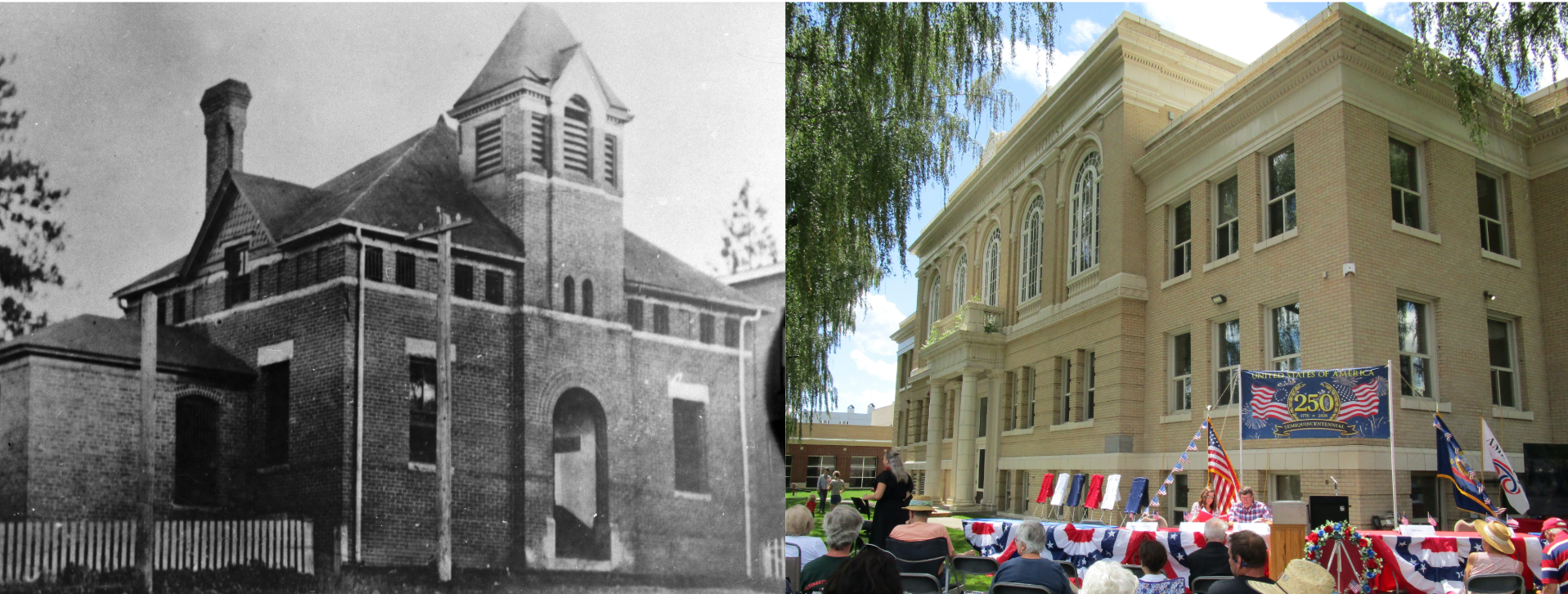
In no particular rush to establish county offices, Kootenai County funded the construction of a small jail in Rathdrum in 1882,[27] and “a session of the district court was held in Coeur d’Alene that year, Judge Norman Buck presiding.”[28] Kootenai County expanded the building in 1891, after Idaho achieved statehood in 1890. The Romanesque-style building constructed of locally made red brick and stone masonry served as a jail, county offices and included a courtroom, with the Kootenai County sheriff residing in the upper floors.[29]
The first week of March 1892, “district court convened at Rathdrum,”[30] with:
Judge J. Hollman presiding with a full quoto (sic) of officers and attorneys in attendance. The call of the panel for Grand Jury showed all present. They were empaneled without any objections and charged by the judge as to their duties. The calendar was then called and cases set for argument on law questions.[31]
First District Court was held regularly between 1897 and 1908 in what was now referred to as the “Rathdrum courthouse,” with local judges presiding from a desk in a room shared with the county recorder, treasurer, assessor, and the sheriff.
At the same time, settlers finally discovered opportunities to homestead, mine for silver and gold, and work in the white pine lumber industry. The Kootenai County population grew 148%, from 4,108 residents in 1890 to 10,216 residents in 1900.[32] The settlers arrived in Rathdrum on trains owned by local rail magnates Fredrick Blackwell and D.C. Corbin, and then traveled to Coeur d’Alene to catch J.C. White’s Red Collar Line steamboats to Harrison or St. Maries.
Despite Rathdrum’s designation as the county seat, economic activity and wealth ultimately concentrated in the town of Coeur d’Alene. Recognizing the opportunity to improve Coeur d’Alene’s standing and promote the tourism industry on Lake Coeur d’Alene, local business leaders, including Oscar F. Canfield, formed the Coeur d’Alene Commercial Club in 1903.[33] Between 1903 and 1908, the Club’s primary goal was to incorporate Coeur d’Alene and become the seat of Kootenai County.
In 1905, the Idaho Legislature passed, and Governor Frank Gooding signed, Senate Bill 64, the “Spaulding Bill,” named after Senator Henry H. Spaulding of Lapwai. This bill, physically carried by Senator Herman Taylor from Sandpoint to Boise,[34] abolished Kootenai County and created two new counties: Lewis County with Coeur d’Alene as the county seat, and Clark County with Sandpoint as the county seat.[35]
Kootenai County officials in Rathdrum asserted that the Idaho Legislature did not have the authority to abolish Kootenai County, much less name the new counties after explorers who did not set foot near Lake Coeur d’Alene. On March 3, 1905, the Rathdrum Tribune reported that Kootenai County officials would challenge the Spaulding Bill, under the headline: “The Constitutionality of the Division Bill, Proceedings to Test the Question, Have Begun. Rathdrum raises money for the purpose. The Legal Firm of Wood and Wilson of Boise have been employed.”[36] Ultimately, it was the Idaho Supreme Court that declared the Spaulding Bill unconstitutional in McDonald v. Doust, 11 Idaho 14, 81 P. 60 (1905), holding that the Idaho Legislature could not abolish a county.[37]
Undeterred, the Coeur d’Alene Commercial Club expressed a sudden interest in formalizing and stabilizing county governance as a reason to move the county seat to Coeur d’Alene, arguing that county officials could not possibly govern from Rathdrum’s 14-year-old “outdated courthouse.”[38] The City of Coeur d’Alene incorporated in 1906 and city council members negotiated with the Kootenai County commissioners to share public facilities, on the condition that Coeur d’Alene was designated the county seat.[39]
On February 21, 1907, the Idaho Legislature passed the “Bonner County Division Bill,” creating Bonner County from the northern half of Kootenai County.[40] Governor Gooding signed the bill on February 22, 1907 and the border change reinvigorated the Coeur d’Alene Commercial Club’s efforts to relocate the county seat.[41] However, the City of Coeur d’Alene did not own public buildings that would house both city and county offices, and Kootenai County owned a public building in Rathdrum.
The City of Coeur d’Alene remedied this minor deficiency by building a new City Hall at Fifth Street and Sherman Avenue on June 9, 1908.[42] The Coeur d’Alene Commercial Club thereafter successfully gathered 6,000 signatures in favor of moving the county seat to Coeur d’Alene.[43] After a campaign of ballot stuffing and arm twisting, on November 3, 1908, a majority of voters selected Coeur d’Alene as the seat of Kootenai County. Kootenai County moved into the Coeur d’Alene City Hall in 1909, abandoning the county owned building in Rathdrum.[44]
Kootenai County and the City of Coeur d’Alene jointly operated out of the Coeur d’Alene City Hall, but it appears the arrangement was intended to be short lived. The local papers reported that county commissioners C.M. Trigg and V.W. Waitman traveled to Washington and Montana in 1909 to “inspect courthouses” as possible models for a new Kootenai County courthouse.[45]
In contrast, most of Idaho’s counties had constructed county courthouses, including First District counties Bonner County in 1907-1908 and Shoshone County in 1907.[46] In 1908 Senator Borah, working with the Coeur d’Alene Commercial Club, worked with Senator Heyburn to secure funding for a federal courthouse in Coeur d’Alene (instead of Moscow) and eventually succeeded in 1912.[47] It appeared that the surrounding counties and federal government were outpacing Kootenai County’s progress.
Meanwhile, Judges William Wells Woods and A.V. Chamberline occasionally held court in Coeur d’Alene’s City Hall.[48] William McNaughton, John P. Gray, and a few other attorneys practiced throughout the First Judicial District.
By 1914, the people of St. Maries at the south end of Lake Coeur d’Alene recognized that “the trade and commerce of the inhabitants of this territory naturally flow southward and . . . includes no territory that is a tributary to any city or town in Kootenai County . . .”.[49] On November 3, 1914, the citizens of Kootenai County voted in favor of the creation of “Benwah (sic) County,” advising the Idaho Legislature to divide the southern end of Kootenai County. On January 23, 1915, the Idaho Legislature once again changed Kootenai County’s boundaries by creating Benewah County, named after a Coeur d’Alene chief. Never mind that the act divided the 1891 Coeur d’Alene Reservation, locating portions in both Kootenai and Benewah Counties.
Eight years later, Benewah County hired Meyers & Telender architect Julius Zittel of Spokane to build a three story Classical Revival courthouse building that was completed in St. Maries in 1924.[50] Kootenai County, however, continued to operate out of the Coeur d’Alene City Hall, and remained without a courthouse or county-owned facilities.
A “Fireproof” Courthouse
Kootenai County ran its first public bond election on May 16, 1925, seeking $120,000 to build a “fireproof” courthouse designed by Julius Zittle.[51] The design selected was a buff-colored brick, Georgian Revival building design that featured an elegant portico, supported by Doric columns and arched second-floor windows adorned with terracotta ornamentation.[52]
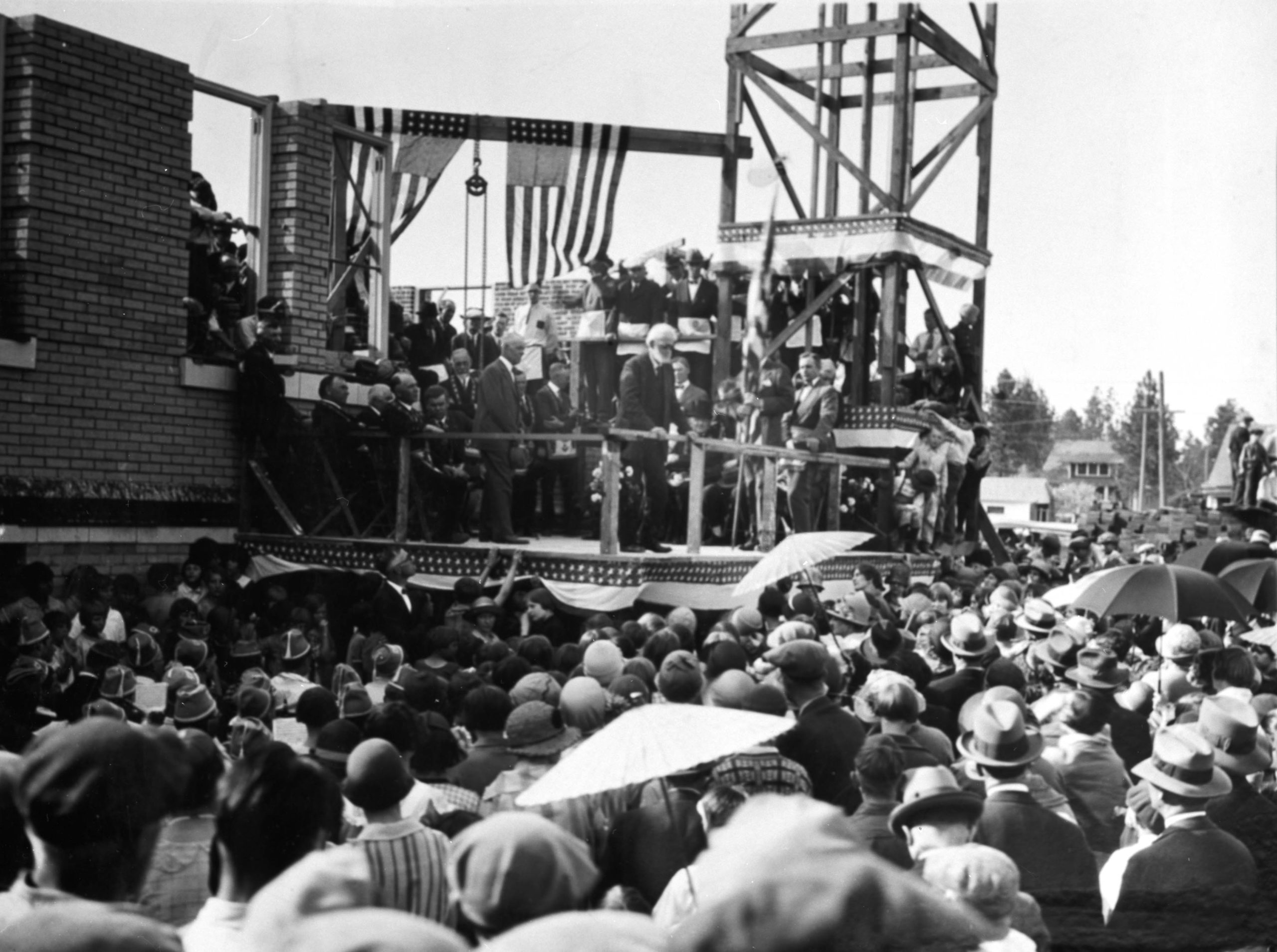
The bond passed, and Kootenai County Commissioners J.W. McCrea, Frank A. Morris, and Hans Johnson, purchased land at the intersection of Government Way and Northwest Boulevard in Coeur d’Alene. Construction began in the Fall of 1926, and Oscar F. Canfield was tasked with laying a time capsule in the building cornerstone on April 26, 1926.
Each of the Kootenai County newspapers contributed an issue dated in April 1926 to the time capsule. The Post Falls Advance, Harrison Searchlight, Spirit Lake Herald, and Coeur d’Alene Evening Press ran articles about the new courthouse; The Rathdrum Tribune did not mention the event. Other items in the time capsule included a magazine about Coeur d’Alene, a page of signatures from each elected county official, a copy of the Coeur d’Alene High School student paper, records from banks and the school district, and a copy of the 58th Annual 1925 Communication of the Grand Lodge of Idaho A.F. & A.M. (Masonic Lodge).
A crowd gathered before 88-year-old Oscar F. Canfield as he stood on an elevated platform and placed the sealed copper box in the shiny gray cornerstone located some ten feet above the ground. Oscar reminisced about:
The great advancements since he first looked on what is now Kootenai County 42-years-ago. At the time, there were but two white women in the county, and it was hard to find enough people to properly organize it.[53]
It was sealed with cement, and the outside inscribed with the names of the current Kootenai County Commissioners.
District Judge William F. McNaughton also spoke, opining about the importance of public education:
In the many year that he has been on the bench he has noticed that of the hundreds of people he has sentenced . . . there have not been many high school graduates. . . . and were sent into the world undeveloped and unsettled in their convictions and too easy fall victim to the seduction of crime.[54]
The Grand Lodge of Idaho A.F. & A.M. performed a Masonic ceremony to consecrate and “inter the casket.” Interning the time capsule was the last public act Oscar F. Canfield performed, as he passed away a few months later on October 8, 1926. In December 1926, the Kootenai County Courthouse opened for business.
Retrieving History from a Cemented Legacy
The Kootenai County Courthouse was listed on the National Register of Historic Places in 1977, and the beautiful buff brick remains unchanged since 1926. Like many historic public buildings, however, modernization efforts have drastically altered the interior to accommodate modern uses, disability access, and security needs. When I worked at the building for a short time I found the modifications aesthetically inconsistent and thoughtless, resulting in a cramped, noisy, inconvenient, and difficult to navigate workplace.
Local architect Jon Mueller, however, has a great appreciation for the building’s design and led the Kootenai County Historic Preservation Commission (KCHPC) on a two-year mission to celebrate the Kootenai County Courthouse’s centennial anniversary. Along with the other members of the KCHPC, I began researching the building’s history in earnest. While at the Idaho Historical Society Archives in Boise, I came across an advertisement from 1986 that dropped a clue about the existence of a time capsule in the building cornerstone. Jon Mueller and local historian Stephen Sheppard ultimately confirmed the time capsule’s existence and location. Retrieving the time capsule provided these two life-long Coeur d’Alene residents with a meaningful, personal connection to Oscar F. Canfield and their shared history in Kootenai County.
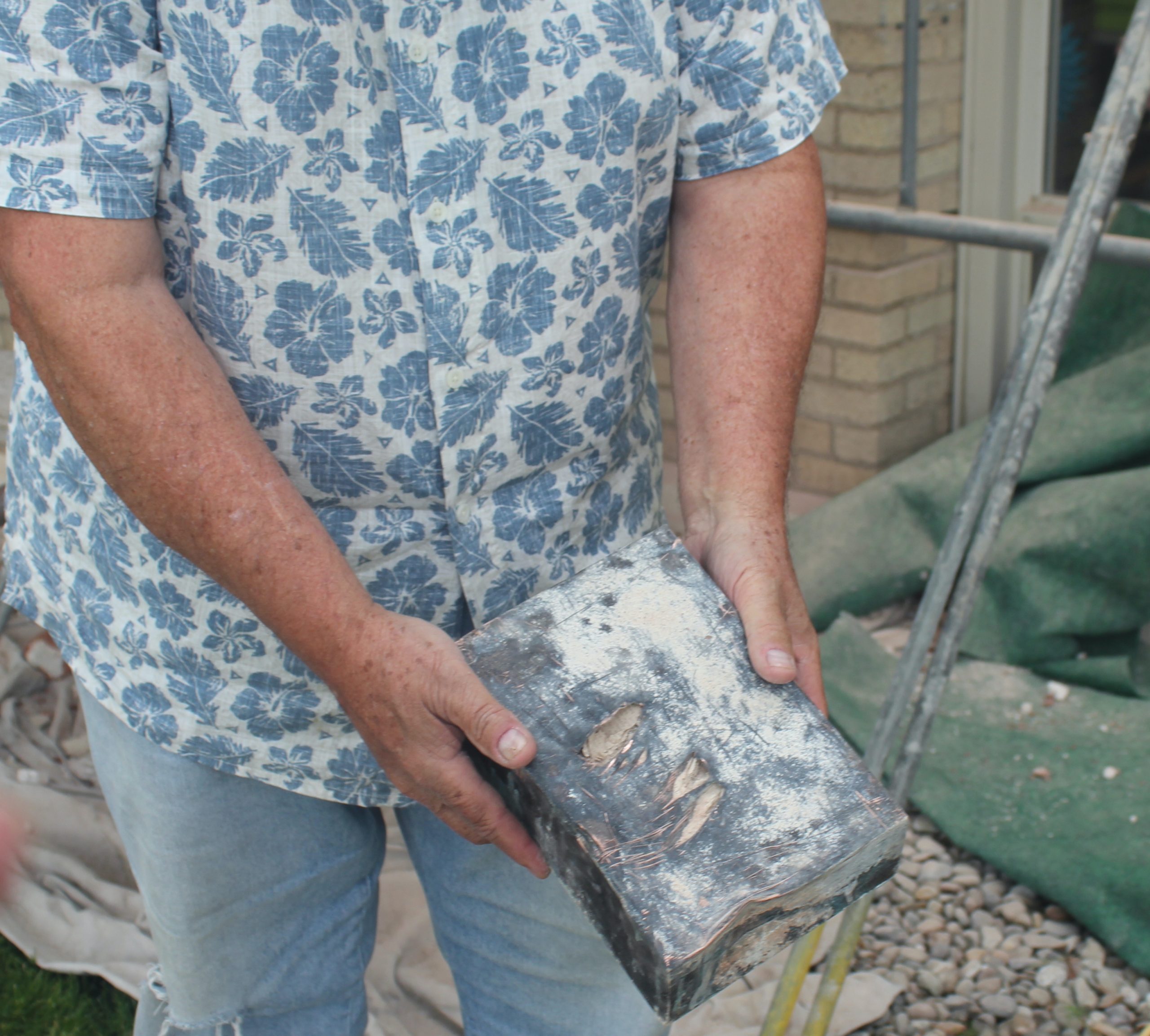
On June 3, 2026, the sealed copper box was extracted and opened by museum professional Elizabeth Boutin (who kindly let me put on some gloves and assist!). Prying back the copper top, we revealed a stack of perfectly preserved documents, and two very decomposed rubber bands. On July 3, 2026, in celebration of America’s 250th anniversary, Idaho’s 136th statehood anniversary, and the building’s centennial, the KCHPC displayed photos of the time capsule contents and celebrated Kootenai County at a public event with 450 citizens. Following the example of Oscar F. Canfield and Judge McNaughton, Idaho Supreme Court Justice Cynthia Meyer (a long-time resident and former First District Judge) joined Jon Mueller at the lectern, as the Grand Lodge of Idaho A.F. & A.M. performed a consecration ceremony over a new, 2026 time capsule.
Epilogue
Similar to the Canfield family, five generations ago my ancestors made their way to Southeastern Idaho in the 1860s and 1870s, and our clans have stuck solidly to the Teton Valley and Snake River Plain. To me, the “romance in her name” means ranches, high arid peaks, potato fields, and rivers. Even so, like 60% of the Kootenai County population, I moved to North Idaho within the last twenty years.
Most Kootenai County “transplants” followed Oscar F. Canfield’s path from California to North Idaho. They are curious and wish to connect to Kootenai County’s values of freedom, independence, and opportunity. I enjoy sharing a “new to me” Idaho story when I guide the recently relocated on walking tours or host lectures for the Museum of North Idaho. Introductions invariably begin with the attendees asking if I am from Idaho, and I have the privilege of saying that “I am a fifth-generation Idahoan.” Still, I am not comfortable giving the impression that I have a connection to North Idaho’s history, so I qualify the statement with “…but from Southeastern Idaho.”
Long-time Kootenai County residents lament the loss of their historic buildings, and neighborhoods, as well as the loss of space and land. Constant construction and boundary changes are visible from the top of Canfield Mountain where the panoramic view of the Rathdrum Prairie and Lake Coeur d’Alene stretches between pine trees and cell phone towers. Roads crisscross over ever shrinking patches of farmland, like arms reaching out to touch hands between subdivisions on the edges of Post Falls, Rathdrum, and Hayden. The view also extends over the western horizon, where the Washington state line is unidentifiable in the constant stream of traffic flowing to and from Spokane Valley on I-90.
The view from the peak of Canfield Mountain reflects the imminent connection of municipal boundaries that will ultimately limit Kootenai County’s influence. Arguably, though, Kootenai County’s geographical borders have always seemed to lack meaning to the residents as they comingled their lives and economies across lakes, mountain ranges, prairies, and state lines. Instead, for the foreseeable future, Kootenai County will retain its meaning and remain anchored in history through the gray cornerstone in a century old building at the center of Coeur d’Alene.

Courtney E. Beebe is a fourth generation Idaho lawyer, certified professional mediator, and a Lead ALJ for the State of Washington OAH. She has a B.A. in history from the University of Montana, a Certificate of Museum Studies from University of Washington, and attended the University of Idaho College of Law. ALJ Beebe also volunteers as a public historian and operates Beebe Mediation, PLLC in Idaho.
[1] Oregon Spectator, December 9, 1847.
[2] Oregon Spectator, January 20, 1848.
[3] Ambrose, S.E., Undaunted Courage: Meriwether Lewis, Thomas Jefferson, and the Opening of the American West (New York: Simon & Schuster, 1996).
[4] Hardee, Jim, Pierre’s Hole: The History of a Fur Trade Landmark (Museum of the Mountain Man, Sublette County Historical Society, Soft Cover Edition, 2022).
[5] Enzler, Jerry, Jim Bridger: Trailblazer of the American West (University of Oklahoma Press, 2023).
[6] Drury, Clifford Merrill, Marcus and Narcissa Whitman and the Opening of Old Oregon, Vols. 1 and 2 (Arthur H. Clark Company, 1973).
[7] Enzler, Jerry, Jim Bridger: Trailblazer of the American West (University of Oklahoma Press, 2023).
[8] Perret, Robert, Editor, Here We Have 150 Years of Idaho History: A Bibliography. (University of Idaho Library, August 2014).
[9] Nisbet, Jack, Sources of the River: Tracking David Thompson Across Western North America (Sasquatch Books, Seattle, 2007).
[10] Singletary, Robert, Coeur d’Alene Beautiful and Progressive: An Illustrated History of Coeur d’Alene Idaho 1878-1900, (Museum of North Idaho, 2019).
[11] Eberlein, Jake, Wilderness Cathedral: The Story of Idaho’s Oldest Building (Mediatrix Press, 2017).
[12] McDermott, Paul D., Ronald E. Grim, and Philip Mobley, Editors, The Mullan Road: Carving a Passage through the Frontier Northwest, 1859-1862 (Mountain Press Publishing, 2015).
[13] Nez Perce National Historic Park (2020) https://www.nps.gov/nepe/learn/historyculture/pierce-courthouse-history.htm.
[14] Singletary, Robert, Coeur d’Alene Beautiful and Progressive: An Illustrated History of Coeur d’Alene Idaho 1878-1900, (Museum of North Idaho, 2019).
[15] Id.
[16] Id.
[17] Meinig, D.W., The Great Columbia Plain (University of Washington Press, 1995).
[18] Singletary, Robert, Kootenai Chronicles: A History of Kootenai County, Volume 1 (Museum of North Idaho, 1997).
[19] “An Act Defining the Boundary Lines of Counties west of the Rocky Mountains,” Session Laws of Idaho Territory: 1863-1864.
[20] Session Laws of the Territory of Washington (James Lodge Public Printer, February 10, 2016).
[21] Ninth Census – Volume 1 (Washington Government Printing Office, 1872).
[22] Counties Which No Longer Exist, Idaho State Historical Society Reference Series (1962).
[23] Singletary, Robert, Coeur d’Alene Beautiful and Progressive: An Illustrated History of Coeur d’Alene Idaho 1878-1900, (Museum of North Idaho, 2019).
[24] Id.
[25] Id.
[26] Id.
[27] National Register of Historic Places Registration Form for Old Kootenai County Jail, July 2001 (Idaho State Historical Society).
[28] Coeur d’Alene Press, April 27, 1909 “Some Early Day History: Coeur d’Alene and Kootenai County Frontier Days.”
[29] National Register of Historic Places Registration Form for Old Kootenai County Jail, July 2001 (Idaho State Historical Society).
[30] Coeur d’Alene Press, February 27, 1892.
[31] Coeur d’Alene Press, March 5, 1892.
[32] Census Bulletin No. 28, Twelfth Census of the United States, November 28, 1900.
[33] Singletary, Robert, Coeur d’Alene Beautiful and Progressive: An Illustrated History of Coeur d’Alene Idaho 1878-1900, (Museum of North Idaho, 2019).
[34] Coeur d’Alene Press, January 14, 1905.
[35] Counties Which No Longer Exist, Idaho State Historical Society Reference Series (1962).
[36] The Rathdrum Tribune (Succeeding The Silver Blade), March 3, 1905.
[37] McDonald v. Doust, 11 Idaho 14; 81 P 60 (1905).
[38] Singletary, Robert, Coeur d’Alene Beautiful and Progressive: An Illustrated History of Coeur d’Alene Idaho 1878-1900, (Museum of North Idaho, 2019).
[39] Id.
[40] Idaho Atlas of Historical County Boundaries (The Newberry Library, 2010).
[41] Singletary, Robert, Coeur d’Alene Beautiful and Progressive: An Illustrated History of Coeur d’Alene Idaho 1878-1900, (Museum of North Idaho, 2019).
[42] National Register of Historic Places Registration Form, May 21, 1979.
[43] Singletary, Robert, Coeur d’Alene Beautiful and Progressive: An Illustrated History of Coeur d’Alene Idaho 1878-1900, (Museum of North Idaho, 2019).
[44] National Register of Historic Places Registration Form, May 21, 1979.
[45] “County to Build Soon? Commissioners Make Long Trips to See Courthouses,” The Silver Blade, March 5, 1909. “Lewistown Courthouse Best,” The Silver Blade, March 19, 1909.
[46] Gunter, Bob, Order in the Court House (Bonner County Daily Bee, October 14, 2009); National Register of Historic Places Nomination Form, Shoshone County Courthouse, August 10, 1979.
[47] Western Union Telegram, From Coeur d’Alene Commercial Club to Senator William Borah, December 5, 1908 (Museum of North Idaho Archive, Object ID: 1971.4.8).
[48] Under Provisions of New Judicial District Law, Coeur d’Alene Press, March 8, 1909.
[49] “Benwah (sic) County A Practical Division,” The Silver Blade, October 30, 1914.
[50] National Register of Historic Places Registration Form, Benewah County Courthouse, August 13, 1987.
[51] Advertisement for Bond Election.
[52] National Register of Historic Places Application, Kootenai County Courthouse 1977.
[53] Coeur d’Alene Press, April 27, 1926.
[54] Id.